
Stop Guessing: A Five-Minute Way to Choose an HF Band
When you ask, which HF band is open, the honest answer is: open for whom, to where, by which mode, at what time, and under what solar and geomagnetic conditions? A generic “band conditions” widget may be convenient, but it often hides the details that matter to an operator sitting at a real radio with a real antenna.
A better approach is to combine three kinds of evidence: current space-weather conditions, propagation prediction, and live reports from stations that are actually being heard. None of these guarantees a QSO, but together they can help you make a smart first call on 10, 12, 15, 17, 20, 40, or 80 meters.
The workflow below is designed for everyday HF operating in late 2026 and beyond, while Solar Cycle 25 remains a practical factor. It does not depend on hype, folklore, or one-size-fits-all band charts. It gives you a repeatable way to decide where to call CQ, where to listen, and when to move.
The Three Questions That Matter
Before opening a website, decide what you are trying to do. Propagation is path-specific. “The band is open” means very little unless you define the path.
- Where are you trying to work? Local, regional, opposite coast, Caribbean, Europe, South America, Pacific, or worldwide DX?
- What mode are you using? CW and weak-signal digital modes may succeed when SSB is marginal. AM and wide signals need stronger conditions.
- What antenna and power are realistic? A full-size high dipole, a vertical with radials, a compromised indoor antenna, and a portable wire will not behave the same.
For a practical example, suppose you are in the central United States and want to call CQ on SSB for domestic or DX contacts. Your candidate bands are 10, 12, 15, 17, 20, 40, and 80 meters. The goal is not to find a perfect band; it is to pick the best first band and have a backup.
Step 1: Check SWPC for Space-Weather Red Flags
Start with the NOAA Space Weather Prediction Center’s Radio Communications page. You are looking for conditions that can make HF unusually good, unusually poor, or highly uneven.
What to Look For First
- Geomagnetic activity: Elevated Kp or active storm conditions can disturb polar and high-latitude paths, increase fading, and make higher-band propagation less stable. Mid-latitude paths may still work, but do not assume yesterday’s route will behave the same way.
- Solar flares and radio blackouts: Strong X-ray events can cause shortwave fadeouts on the sunlit side of Earth. If the dashboard indicates an ongoing or recent radio blackout, high-frequency daytime paths may be affected.
- Solar radiation storm information: This is especially relevant to polar paths and aviation-style HF concerns, but amateurs chasing high-latitude DX should still pay attention.
- Solar-cycle context: Higher solar activity often improves the odds for 10, 12, and 15 meters, but it can also bring flare and geomagnetic complications.
Do not overinterpret a single number. A high solar flux value can support higher MUFs, but a disturbed geomagnetic field can make some paths noisy, fluttery, or unreliable. Likewise, a quiet geomagnetic field does not magically open 10 meters at midnight on every path.
A Simple SWPC Decision Screen
- If conditions are quiet: Continue to VOACAP and give the higher bands a fair look during daylight.
- If geomagnetic conditions are unsettled or stormy: Be cautious with polar DX assumptions. Check live evidence before investing time on 10 or 12 meters.
- If a radio blackout is in progress: Consider lower bands, wait, or aim for paths not on the sunlit affected side. Verify with live spots.
For broader solar-cycle background, NOAA’s Solar Cycle Progression page and NASA’s Solar Cycle Progression and Forecast page are useful context sources. They help explain why higher bands may be more active during some years than others, but they do not replace checking today’s conditions.
Step 2: Use VOACAP to Predict the Path, Not the Whole Band
Next, open VOACAP Online. Prediction tools are not live propagation meters. They are models based on location, date, time, frequency, antenna assumptions, power, and ionospheric data. Their strength is showing which paths and times are plausible.
Enter your approximate location and the target region. Use honest station assumptions. If you are running 100 watts to a low wire, do not model yourself as a high-power station with stacked beams. Prediction accuracy suffers when the station description is fantasy.
Run the Candidate Bands
Check the frequencies closest to the bands you are considering. You do not need to obsess over exact calling frequencies; you are trying to compare 28 MHz, 24 MHz, 21 MHz, 18 MHz, 14 MHz, 7 MHz, and 3.5 MHz behavior for your path and current time window.
- 10 meters: Best considered for daylight and early evening paths when the predicted MUF supports it and live evidence exists. Excellent when open, but often path-selective.
- 12 meters: Similar to 10 meters but sometimes useful when 10 is marginal. As a WARC band, operating style is usually more casual than contest-heavy.
- 15 meters: Often a strong daylight DX band during favorable solar-cycle periods. It is a good first check when 10 meters looks doubtful but the ionosphere is still supporting upper HF.
- 17 meters: A practical bridge between 15 and 20. It can be less crowded and very useful for DX when 20 is busy or noisy.
- 20 meters: The dependable middle choice for many daytime and evening DX paths. It is not always the best band, but it is often worth checking.
- 40 meters: Stronger at night and around sunrise or sunset for longer paths. During the day, D-layer absorption can limit distance, though regional work may remain possible.
- 80 meters: Primarily a night and low-sun band for most amateur purposes. Expect higher noise and larger antennas to matter more.
Look for the band with the best combination of predicted reliability, usable signal strength, and the operating window you actually have. If VOACAP says 15 meters has a favorable path for the next hour and 10 meters is marginal, start on 15 unless live evidence strongly disagrees.
Step 3: Verify With Live Received-Signal Evidence
Prediction is useful, but the ionosphere gets the final vote. Before calling CQ, check live spots and received-signal reports. Depending on your mode, that may include DX clusters, Reverse Beacon Network reports for CW and digital skimmers, FT8/FT4 spotting networks, or panadapter observations from your own receiver.
The key is to read spots intelligently. A spot is not proof that you will make the same contact. It may reflect a high-gain antenna, a rare station attracting callers, a different location, or a mode with better weak-signal performance than SSB. But spots are excellent evidence that RF is crossing a path right now.
How to Read Live Spots Without Fooling Yourself
- Filter by geography: Spots from your region matter more than spots from another continent.
- Filter by band: If many nearby stations are hearing Europe on 15 meters, that is stronger evidence than a single distant spot.
- Watch direction: If the eastern U.S. is hearing Europe on 10 meters, that does not automatically mean the western U.S. has the same opening.
- Compare modes: FT8 spots may appear before SSB is workable. CW may remain practical when phone sounds weak.
- Look for clusters of reports: Several independent reports over several minutes are more meaningful than one isolated spot.
If your radio has a waterfall, use it. A quiet waterfall does not prove a band is closed, but visible signal clusters are strong evidence. Tune across known activity areas within your license privileges and applicable band plan. Listen before transmitting.
A Practical Band-Picking Workflow
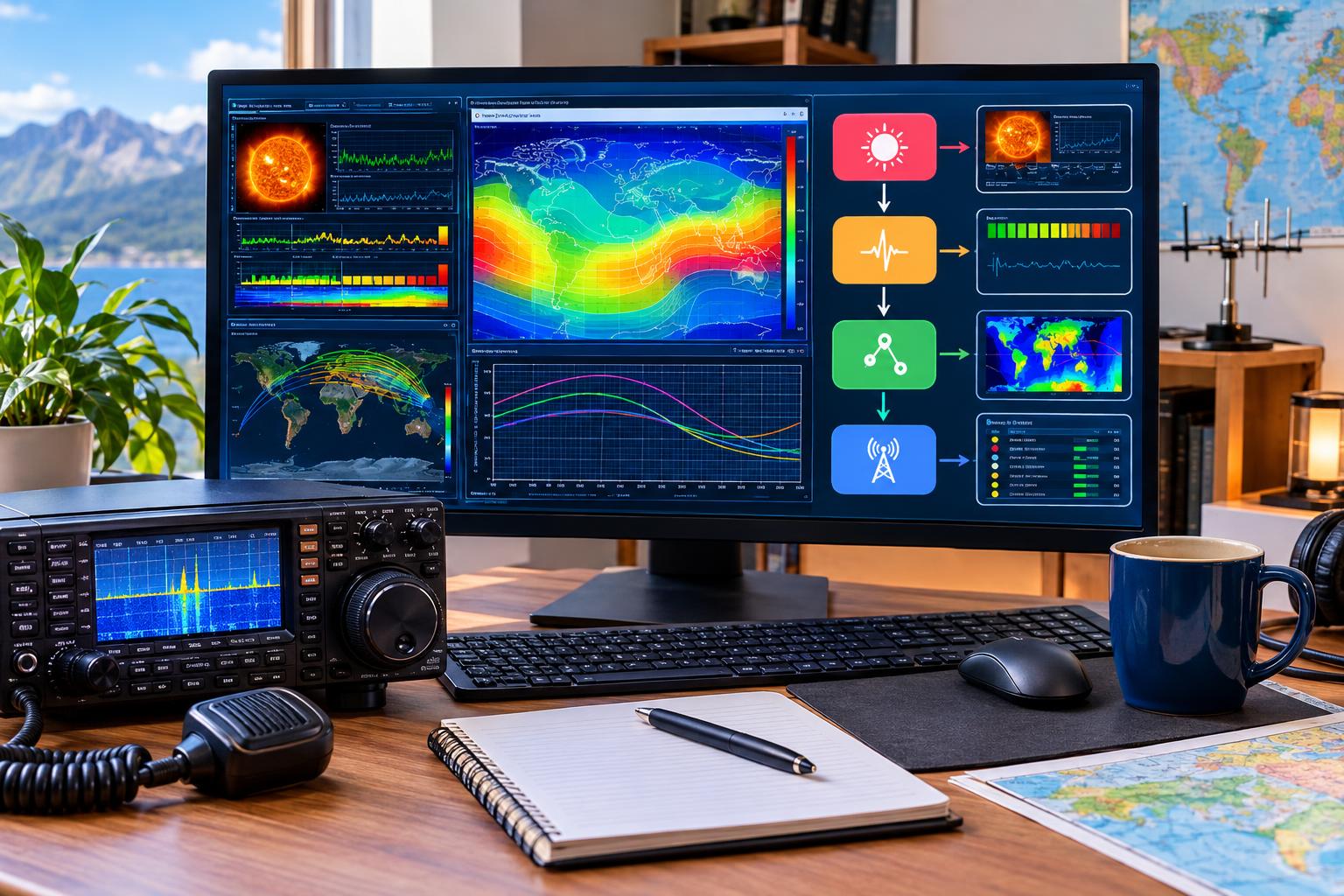
Here is the five-minute version you can use at the operating desk.
Minute 1: Define the Mission
Choose the target and mode: “I want domestic SSB,” “I want Europe on CW,” “I want South America on 10 meters,” or “I want any casual QSO before dinner.” This prevents you from judging a band by the wrong path.
Minute 2: Check SWPC
Look for radio blackouts, geomagnetic disturbance, and overall solar context. If the sunlit HF path is under a blackout, adjust expectations. If the geomagnetic field is disturbed, be skeptical of polar and high-latitude routes.
Minute 3: Run VOACAP
Compare your target path on 10 through 80 meters. Identify the top two candidate bands. If the higher bands are predicted well, give them a chance before automatically defaulting to 20 meters.
Minute 4: Check Live Spots
Look for stations near your area hearing or being heard on those bands. Give extra weight to reports matching your mode and target direction. If live evidence contradicts the model, investigate rather than blindly trusting either one.
Minute 5: Listen, Call, and Time-Box
Listen for two or three minutes. If signals are present, call CQ or answer someone. If you call CQ, give the band a fair but limited trial. If nothing happens after a reasonable effort, move to your backup band. Do not spend the whole evening proving that a dead path is dead.
Worked Examples
Example 1: Afternoon DX From the Midwest
You are in Missouri on a weekend afternoon and want DX on SSB. SWPC shows no obvious radio blackout and geomagnetic conditions are not severely disturbed. VOACAP suggests 15 meters is more reliable than 10 meters toward Europe for the next hour, while 20 meters also looks usable. Live spots show several central U.S. stations hearing European stations on 15 meters, with fewer reports on 10.
The practical choice is to try 15 meters first, keep 20 meters as the backup, and only sample 10 meters if spots begin building. If you are running a modest antenna, this is more rational than calling blindly on 10 because solar activity is generally favorable.
Example 2: Evening Domestic Contacts
You want casual U.S. QSOs after sunset. VOACAP suggests 40 meters should support broad domestic coverage, while 80 meters may support shorter and regional paths with higher noise. Live spots show strong 40-meter activity from your region. Your local noise on 80 meters is high.
Start on 40 meters. If close-in stations are weak or skip is too long, try 80 meters later in the evening. If 40 is crowded, 17 or 20 may still hold some evening DX depending on season, solar conditions, and path, but they are not automatic substitutes for regional coverage.
Example 3: High Bands Look Tempting, But Spots Are Thin
Solar-cycle conditions make you curious about 10 meters. SWPC looks quiet, and VOACAP shows a possible 10-meter path to South America. However, live spots from your area show little activity on 10 and more consistent reports on 12 and 15.
Try a quick listen on 10 meters, but do not camp there indefinitely. Move to 12 or 15 meters if those bands show actual received signals. A possible opening is worth checking; live evidence helps decide how long to stay.
Common Mistakes That Waste Operating Time
- Using solar flux alone: Solar flux is helpful context, not a complete operating plan.
- Ignoring geomagnetic conditions: Disturbed conditions can make some high-latitude paths unreliable even when higher bands seem promising.
- Trusting spots from the wrong region: A 10-meter opening from Florida does not prove the same opening exists from Oregon.
- Confusing FT8 activity with SSB readiness: Weak-signal digital reports may appear when phone contacts require better conditions, antennas, or timing.
- Never checking the higher bands: During favorable periods of the solar cycle, 10, 12, and 15 meters can be excellent. If you always start and stop on 20, you may miss them.
- Never leaving a band: If no one hears you and you hear no one, use the workflow again and move.
Safety and Regulatory Notes
Propagation planning does not replace legal and safe operating. Stay within your license class privileges, authorized frequency ranges, mode limits, and applicable band plans. In the United States, FCC rules and RF exposure requirements apply; operators outside the U.S. should consult their own regulator.
Also remember basic station safety. Do not adjust antennas during thunderstorms. Use appropriate grounding and lightning protection practices for your station design. Keep people away from antennas during transmitting, especially with high power, indoor antennas, portable verticals, or low wires where RF exposure and contact hazards are more realistic.
FAQ
What is the best all-around HF band to try first?
There is no universal first band. For daytime DX, compare 15, 17, and 20 meters, then check 10 and 12 if solar and live evidence support them. For evening domestic work, 40 meters is often a practical starting point, with 80 meters becoming more useful later and for shorter regional paths.
How do I know if 10 meters is open?
Check SWPC for obvious disturbances, run a path prediction for your target, and then look for live spots from stations near you. Also listen directly. Ten meters can be very path-specific; it may be open to one region and silent in another direction.
Should I trust VOACAP or live spots more?
Use both. VOACAP helps identify plausible paths and times. Live spots show what stations are actually receiving right now. When they agree, confidence improves. When they disagree, listen on the band before deciding.
Why can I hear stations but not get replies?
Propagation may be one-way in practice because of noise, antenna differences, power differences, pileups, or mode choice. The other station may have a much better antenna than you, or your signal may be arriving below their noise floor.
Does Solar Cycle 25 mean 10 meters will always be open?
No. Solar-cycle phase changes the odds, especially for upper HF, but time of day, season, path, geomagnetic activity, flares, antennas, and mode still matter. Treat the solar cycle as context, not a promise.
Key Takeaways
- Ask “which path is open?” rather than only “which band is open?”
- Use SWPC first to identify space-weather problems that can affect HF.
- Use VOACAP to compare specific bands for your location, target, time, and station assumptions.
- Use live spots and your own receiver to confirm what is happening now.
- Give higher bands a fair check during favorable solar-cycle periods, but keep 20, 40, and 80 meters in the plan.
- Time-box your CQ attempts and move when evidence points elsewhere.
The best operators are not guessing randomly, and they are not blindly obeying widgets. They are combining current space weather, realistic prediction, and live received-signal evidence. That habit will not guarantee a contact, but it will help you choose a better band more often and spend more of your operating time where a QSO is actually plausible.