
What changed for used radio listings in 2026?
On October 13, 2026, new FCC marketplace listing requirements took effect for certain radiofrequency devices offered through online marketplaces. For hams, the practical question is not simply “Does this radio have an FCC ID?” It is “Is this particular item required to have one, and does the listing describe the device accurately enough to avoid trouble for the buyer, seller, and station?”
The issue matters because amateur radio equipment sits in an unusual place. Many amateur transmitters intended only for operation in the Amateur Radio Service are not approved in the same way as consumer Wi-Fi routers, FRS handhelds, GMRS radios, Part 90 land-mobile radios, or CB equipment. ARRL reported that eBay restricted certain radio-equipment listings while exempting ham-band-only gear. That exemption is important, but it does not mean every radio marketed to hams is automatically exempt from FCC ID concerns.
This guide focuses on practical marketplace checks for FCC ID ham radio equipment sales, especially used transceivers, amplifiers, handhelds, power supplies, SDRs, and accessories that may affect station setup and interference.
FCC ID is not the same thing as legal amateur operation
An FCC ID is an equipment authorization identifier. It normally appears on devices that have gone through an FCC authorization process, such as certification. It is not a ham license, not proof that you may transmit anywhere the radio can tune, and not a guarantee that the equipment will be clean in your station after years of use or modification.
For amateur operators, a separate rule still applies: you are responsible for operating within your license privileges, using appropriate emissions, avoiding harmful interference, and meeting RF exposure requirements. A radio may have an FCC ID and still be illegal to use on a service for which you are not licensed. Conversely, a genuine amateur-band-only transmitter may not show an FCC ID because amateur transmitting equipment has different equipment authorization treatment than many consumer radio services.
First check: is it truly ham-band-only?
The key marketplace distinction is whether the device is limited to amateur bands or whether it can transmit outside them. Before buying or listing, identify the transmit capability, not just the receive coverage.
Common ham-band-only examples
- HF amateur transceivers intended for 160 through 10 meters, sometimes including 6 meters, with transmit restricted to amateur allocations.
- VHF/UHF mobile or handheld amateur transceivers limited to 2 meters, 70 centimeters, or other amateur bands.
- Amateur-specific QRP kits and home-station radios designed only for Part 97 operation.
Examples that deserve closer scrutiny
- Handhelds or mobiles advertised for “ham, business, public safety, GMRS, FRS, marine, and airband transmit.” Multi-service transmit claims are a warning sign.
- “Unlocked,” “wideband transmit,” “MARS/CAP modified,” or “export” radios. A modification may be legal for a narrow purpose but misleading or unlawful when advertised broadly.
- Radios that look like amateur gear but are actually Part 90 land-mobile radios, CB radios, GMRS radios, or software-defined transmitters capable of operation outside amateur allocations.
- RF amplifiers, signal boosters, and transmit accessories. These may have different marketing and authorization issues than a basic ham transceiver.
If a listing says only “works on all frequencies,” that is not a selling point. For a ham buyer, it is a reason to ask detailed questions.
Buyer checklist before clicking “buy”
A clean listing should help you answer three questions: what is the device, what frequencies can it transmit on, and what condition is its RF output likely to be in?
1. Ask for the exact model and rear-panel label
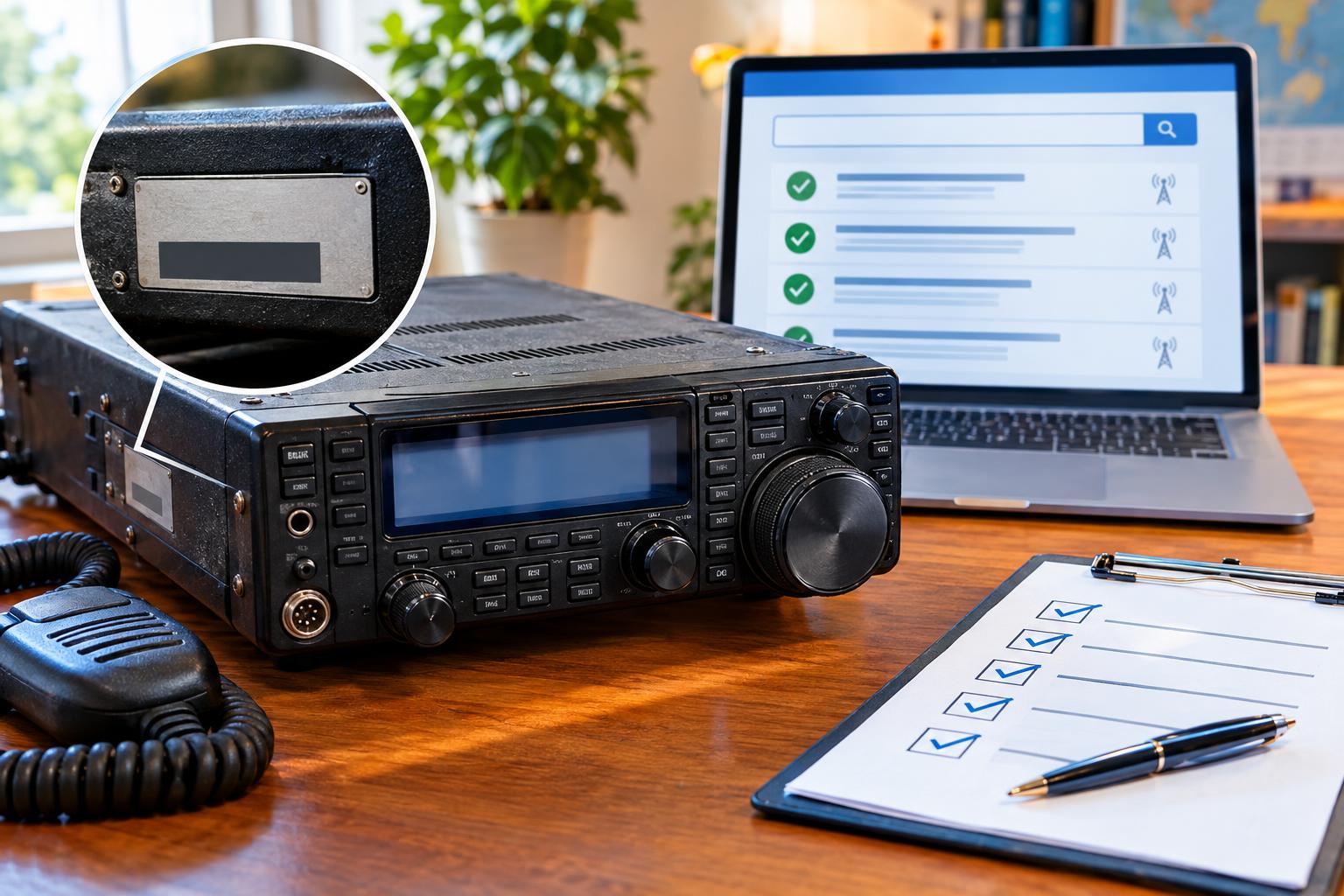
Model names can be confusing. One radio family may include several variants for different markets. Ask for a clear photo of the manufacturer label, serial-number area with private details obscured if desired, and any FCC ID label if present. If there is an FCC ID, compare it with the device model and description rather than relying on a blurry photo or seller claim.
2. Separate receive coverage from transmit coverage
Many amateur radios receive outside the ham bands. Wide receive coverage is common and usually not the issue. The concern is transmit capability. A listing for a used 2-meter/70-centimeter handheld should clearly indicate whether it transmits only on amateur bands or has been modified for broad transmit coverage.
3. Watch for misleading “no license needed” claims
Amateur transmitting requires the appropriate amateur license. A listing that promotes a ham transceiver as license-free, police/fire capable, or suitable for business dispatch should be treated cautiously. Even if the hardware is real, the seller may not understand the regulatory distinction.
4. Consider age, modifications, and RF cleanliness
Used gear can be electrically tired. Final transistors, low-pass filters, transmit/receive relays, shielding, and internal grounding can degrade or be damaged by poor repairs. An FCC ID, where applicable, does not prove a 20-year-old used radio still meets its original performance. If the seller cannot demonstrate basic operation, assume you may need bench work.
5. Think about interference before the box arrives
A bargain radio can become expensive if it causes TVI, audio interference, noise on your own receiver, or neighbor complaints. Plan your station as a system: radio, power supply, bonding, feed line, antenna, computer, USB cables, and nearby consumer electronics.
Seller checklist for accurate used ham listings
If you are selling used amateur equipment, your goal is a clear, narrow, factual listing. Do not overstate coverage, hide modifications, or borrow language from another seller’s listing.
- State the intended service: “Amateur Radio Service transceiver” is clearer than “walkie-talkie for all uses.”
- List transmit bands accurately: Example: “Transmits on 144–148 MHz and 420–450 MHz for licensed amateur use,” if that is correct for the unit.
- Disclose modifications: If the radio has been widebanded, repaired, aligned, or altered, say so. If you do not know, say that instead of guessing.
- Include FCC ID when present: If a device has an FCC ID label, include it accurately. Do not invent one, copy one from a similar model, or list an FCC ID for an accessory as if it belongs to the transmitter.
- Do not imply unauthorized uses: Avoid claims such as “works on police channels,” “business radio,” “GMRS without paperwork,” or “no license required” unless the device and service rules truly support that statement.
- Describe condition honestly: “Receives, transmits into dummy load, power output not laboratory verified” is better than “perfect” when you have not measured spurious emissions, frequency accuracy, or full power across bands.
How this affects station setup and interference
Marketplace compliance and station performance are linked. The same sloppy listing language that hides a questionable transmitter may also hide a radio that is more likely to create interference.
Used HF transceiver example
Suppose you find a used 100-watt HF transceiver listed as “opened for all bands.” Ask what that means. If it was modified for out-of-band transmit, you need to know whether the modification affected filtering, band switching, or alignment. For legal ham operation you still transmit only where permitted by your license. For station cleanliness, you want confidence that harmonics and spurious emissions are controlled on the bands you use.
In the shack, pair the radio with a good 50-ohm dummy load for checks, a resonant or properly matched antenna system, quality coax, and appropriate common-mode chokes where needed. High SWR, RF on the outside of the coax shield, and poor bonding can make a basically sound radio appear “dirty” by putting RF into speakers, USB cables, routers, or alarm systems.
Used VHF/UHF handheld example
A handheld advertised for amateur, GMRS, FRS, marine, and public safety transmit is a red flag. Even if you are licensed as a ham, that does not authorize you to transmit on non-amateur services with unsuitable equipment. For home use, a poorly filtered handheld near computer speakers or a soundbar can produce buzzes and clicks that look like a household electronics problem but start with an unsuitable transmitter and antenna placement.
Practical interference checks after purchase
Once a used radio arrives, do not make your first transmission through the roof antenna at full power. Use a staged check.
- Inspect first: Look for damaged connectors, missing screws, burnt smells, loose heat sinks, crushed coax jumpers, and nonstandard power wiring.
- Use a current-limited supply if appropriate: For DC gear, correct polarity and fuse protection matter. Do not trust unknown power leads.
- Start into a dummy load: A proper dummy load lets you verify basic transmit behavior without radiating a questionable signal.
- Check frequency and power reasonably: Use known-good station instruments if you have them. If not, keep power low until you can get help from a club member or technician.
- Listen locally: Use a second receiver, where appropriate, to check for obvious instability, hum, or intermittent audio. This is not a substitute for lab testing, but it can catch major faults.
- Add the antenna last: Confirm SWR, feed-line condition, and RF bonding. If problems appear only on the antenna, suspect common-mode current, poor grounding, or an antenna-system issue before blaming the marketplace rule.
What to do when a marketplace asks for an FCC ID
If a platform requires an FCC ID field and your item is genuine ham-band-only amateur equipment, follow that platform’s current instructions. ARRL reported that eBay exempted ham-band-only gear, and eBay provides seller guidance for FCC ID information. Marketplace workflows can change, so use the current help page rather than relying on old screenshots or forum posts.
If the item is not ham-band-only, do not force it into a ham exemption. A land-mobile radio, GMRS radio, CB transmitter, Wi-Fi device, wireless microphone, RF amplifier, or SDR transmitter may have separate authorization or listing requirements. When in doubt, describe the item conservatively and consult the FCC’s current guidance or the marketplace’s policy.
Key takeaways
- The 2026 marketplace rule makes listing accuracy more important for used radio equipment.
- Ham-band-only amateur gear may be treated differently from multi-service transmitters, and ARRL reported an eBay exemption for such gear.
- An FCC ID is not a license, not a guarantee of legal use, and not proof that used equipment is still electrically clean.
- Buyers should verify transmit coverage, modifications, labels, and station-interference risk before purchasing.
- Sellers should state amateur-only use clearly, disclose modifications, include FCC ID information when present, and avoid unauthorized-service claims.
FAQs
Does every ham radio need an FCC ID to be sold used?
No. Genuine ham-band-only amateur transmitting equipment may not have an FCC ID in the way many consumer RF devices do. However, marketplace policies may still ask for information, and non-ham-band-only devices can be different.
Is a wideband receive radio a problem?
Not by itself. Many amateur transceivers receive outside ham bands. The more important question is where the radio can transmit and how it is advertised.
Can I sell a modified radio?
Possibly, but disclose the modification accurately and do not market it for unauthorized services. A buyer must still operate within applicable license privileges and rules.
Does an FCC ID prevent interference?
No. It indicates an authorization status for a device as approved, but poor station layout, damaged used equipment, bad coax, high SWR, common-mode current, and noisy power supplies can still cause interference.