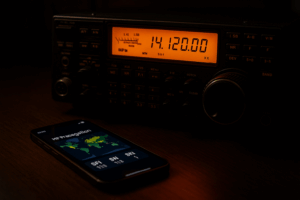


A half-wave dipole is one of the simplest and most useful HF antennas a licensed amateur radio operator can build. Two pieces of wire, a center feed point, some feed line, and suitable supports can put a station on the air without towers, traps, motors, or complicated matching networks. That simplicity is why the dipole is often recommended as a first HF antenna.
But simple does not mean isolated. A dipole is not just the wire you cut on the workbench. Once installed, it becomes part of a system that includes height above ground, geometry, feed-line routing, nearby conductors, trees, wet weather, connectors, chokes, and the way you measure it. Many first-time builders get frustrated because they treat one SWR number as the verdict on the whole antenna. A better approach is to measure and tune the system thoughtfully.
Start with a realistic plan, not just a formula. The familiar starting point for a half-wave dipole is total length in feet equals 468 divided by frequency in MHz. For example, a dipole aimed near 14.200 MHz works out to about 33 feet total, or roughly 16.5 feet per side before allowances. In practice, many builders start a little long to allow for end loops, attachment methods, insulation effects, and final trimming.
The key is to treat the formula as a planning estimate, not a promise. Insulated wire, low height, inverted-V angles, nearby gutters, fences, siding, tree branches, and feed-line coupling can all shift the measured behavior. If the wire is cut to the exact calculated length with no extra adjustment room, the first tuning session may become more difficult than necessary.
Before cutting, decide what job the antenna must do. A full-size 20-meter dipole is manageable for many yards. A 40-meter dipole needs much more length, and an 80-meter dipole needs more still. If you have one high center support but limited end supports, an inverted-V may be more practical than a flat-top. If you want several bands, you may eventually consider fan dipoles, linked dipoles, traps, or doublet-style systems, but the first project is often easier when one band is chosen as the primary target.
Installation height matters because the dipole’s radiation pattern changes with height as a fraction of wavelength. A low 40-meter dipole may work well for regional contacts because much of its energy goes upward at higher angles. The same antenna higher in the air can develop more lower-angle radiation. Neither result is automatically bad. The right question is whether the installation supports your operating goal and can be built safely.
Safety should outrank textbook shape. Keep antennas and supports far from power lines. Consider what happens if a wire, rope, mast, or branch falls. Keep high-voltage wire ends away from people, structures, and places where they can abrade. Use strain relief so the feed-point electrical connections are not carrying all the mechanical load. Add drip loops and weatherproof outdoor connections carefully. A dipole that is safe, serviceable, and slightly imperfect is better than a theoretically ideal installation that is hazardous or impossible to maintain.
When it is time to measure, resist the temptation to transmit once, see an SWR number, and start cutting. SWR is useful, but it is not the entire antenna story. It tells you about the relationship between forward and reflected waves at the point of measurement. It does not prove that the antenna is efficient, that the pattern is ideal, or that the feed line is behaving perfectly.
A sweep is more useful than a single reading. Use an analyzer, VNA-style tool, or careful low-power measurements within your license privileges to plot SWR across the band or across the expected range. Find the low point. If the low point is below your target frequency range, the dipole is usually electrically long. If the low point is above your target range, it is usually electrically short. This pattern tells you what adjustment is likely needed.
Disable the tuner when you are measuring the antenna itself. A tuner can make the transmitter happy, but it does not physically retune the wire. If you tune through a shack tuner and then judge the antenna by the radio’s SWR meter, you may be measuring the tuner’s matching job rather than the antenna’s actual condition. Tuners are useful operating tools, but they can hide information during antenna adjustment.
Trim slowly and symmetrically. Shortening both legs raises the resonant frequency. Lengthening lowers it. If the ends allow fold-back adjustments, use them before making irreversible cuts. On higher bands, small changes can move the low point noticeably. On lower bands, changes are often larger, but you should still work in conservative steps. After each adjustment, return the antenna to its normal operating height and shape before retesting. Measuring with the wire on the ground, hanging at a temporary angle, or near a vehicle can send you in the wrong direction.
Feed-line routing is another common source of confusion. A dipole is balanced, while coax is unbalanced. That does not mean coax cannot be used; it commonly is. But unwanted current can flow on the outside of the coax shield, especially when the feed line leaves the antenna in an unfavorable way or the installation is close to conductive objects. Symptoms can include erratic SWR, noise changes when the coax is moved, RF in the shack, computer or audio problems, or reports that change when you touch station equipment.
A properly rated 1:1 current choke at or near the feed point is often a practical addition for a permanent or house-adjacent coax-fed dipole. In some cases, a second choke near the station may help with remaining common-mode symptoms. Chokes are not magic cures for every problem, but they help the feed line behave more like feed line and less like part of the radiating antenna.
Coax choice also matters, especially as frequency, length, and mismatch increase. Short runs of light coax may be acceptable in some installations, while longer or more permanent runs may justify lower-loss, more rugged cable. A shack tuner does not eliminate loss already occurring along a high-SWR coax run. If the antenna system presents a severe mismatch across a long line, the apparent match at the radio may not tell the whole efficiency story.
Once the antenna is tuned well enough, stop chasing perfection. A dipole does not need a 1.0:1 SWR to be useful. A modest, stable SWR over the part of the band you operate is often a good result. The stopping point should be based on practical band coverage, safe operation, and repeatable measurements, not on a perfect number that may shift with rain, height changes, or nearby objects.
Finally, evaluate performance over multiple operating sessions. HF propagation changes by band, time of day, season, solar conditions, mode, and the other station’s antenna. A quiet afternoon on 10 meters or a poor signal report on 40 meters does not automatically mean your dipole failed. Keep notes: final leg lengths, height, geometry, feed line, choke placement, SWR curves, weather conditions, and on-air observations. Those notes become your baseline when troubleshooting later.
If the system changes suddenly, troubleshoot before trimming. Check the radio and meter against a dummy load. Inspect patch cables and connectors. Look for water intrusion at the feed point, damaged insulation, branch abrasion, loose strain relief, or a changed feed-line path. Compare the new SWR curve with your recorded normal curve. A sharp, sudden change is often a fault, not an invitation to cut wire.
The dipole’s great advantage is that it teaches fundamentals while putting a practical signal on the air. Build it carefully, measure it as a complete system, adjust it methodically, and judge it over real operating time. For a step-by-step guide to that process, Duarte Lickfold’s Tame Your First HF Dipole walks through choosing a band, cutting and installing the antenna, measuring SWR, tuning, feed-line decisions, common-mode current, and troubleshooting a first HF wire dipole in a realistic, beginner-friendly way.
Explore the Book
Continue learning with Tame Your First HF Dipole by Duarte Lickfold, published by Lickfold Digital Publishers.