
POTA Club Activation Logging: The Problem Behind Most Lost Credit
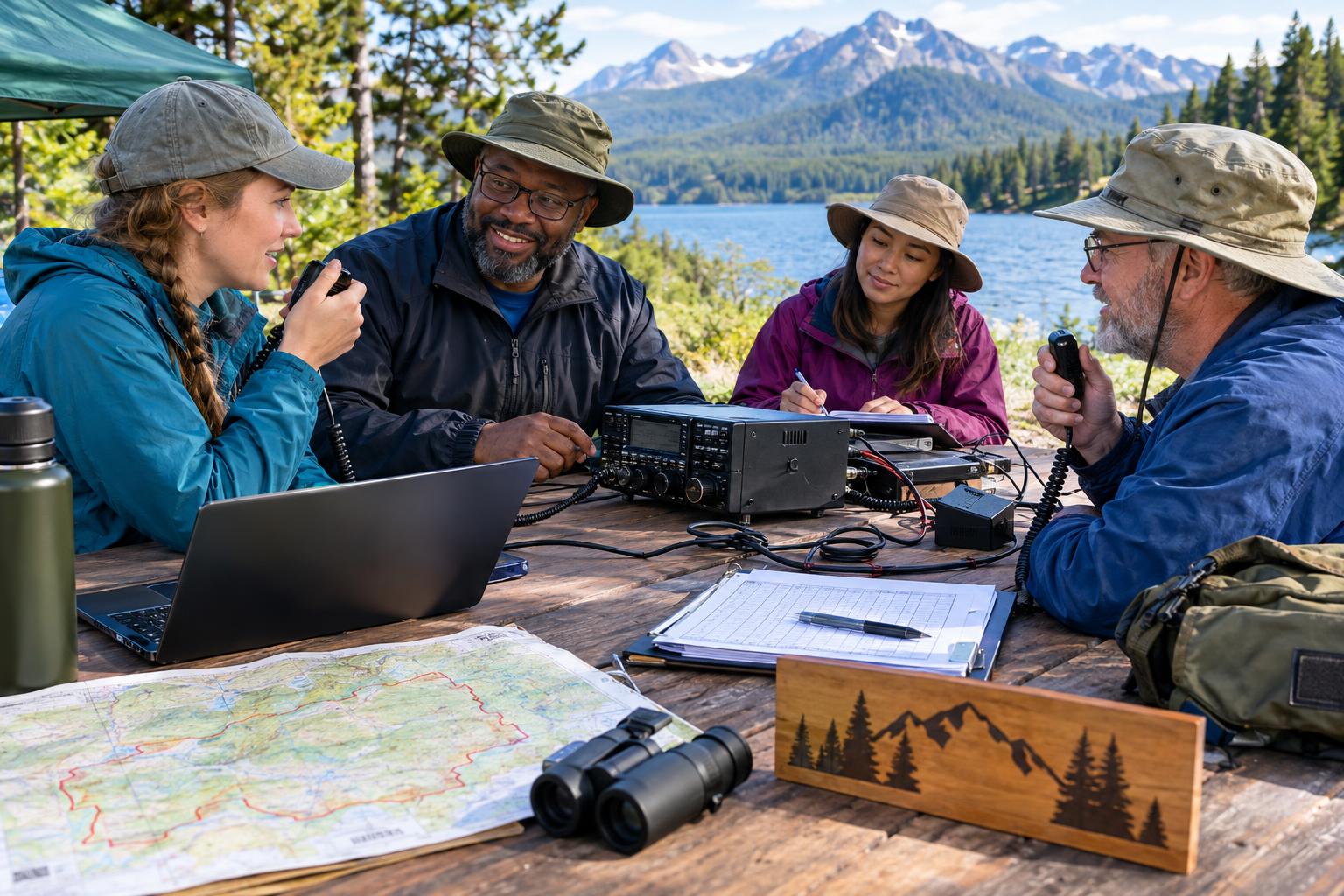
Parks on the Air club activations are great for training new operators, sharing equipment, and making a field day feel productive without turning it into a contest. They also create one of the easiest logging traps in POTA: several licensed operators, one station, one club callsign, multiple parks or park-to-park contacts, and a log file that may not say who actually made each QSO.
The essential rule is simple: the callsign used on the air and the person who actually operated must be represented correctly in the log. If the group uses a club callsign, the log needs to distinguish the station callsign from the individual operator. If several operators want activation credit, each operator must actually make contacts. The July and August 2026 POTA documentation updates clarified this point: credit is not created merely by being present at the activation site or by having your name on a group log.
This article focuses on practical, noncommercial guidance for POTA club activation logging: when to use the club callsign, how to pass the mic properly, which ADIF fields matter, how duplicates are treated, and how park-to-park edge cases can go wrong.
Start With the Callsign Used on the Air
Before anyone calls CQ, decide what callsign the station will transmit. That decision drives the entire log.
Using the club callsign
Use the club callsign when the group wants the activation to represent the club station on the air, when the club trustee or authorized control operator has permitted its use, and when the operators understand how credit will be assigned. In US amateur practice, remember that a club callsign does not remove normal FCC responsibilities. A properly licensed control operator is still responsible for the transmissions, operators must stay within the privileges allowed for the operation, and the station must identify correctly.
For POTA logging, the club callsign is typically the station callsign: the callsign sent over the air and heard by hunters. The individual at the microphone or key is the operator. If the log does not capture that distinction, POTA may not know which individual should receive activator credit.
Using each operator’s personal callsign
Use personal callsigns when each operator wants a clean, separate activation under their own call. This is often simpler for small groups: W1ABC makes contacts as W1ABC, then N2XYZ makes contacts as N2XYZ. Each operator keeps or exports a separate log using the callsign actually transmitted.
The tradeoff is on-air clarity. Hunters need to know which callsign they worked. If the group rapidly switches callsigns, announce the change clearly: for example, “This is now N2XYZ at K-1234.” Do not let hunters assume they are still working the earlier club or personal call.
The Mic-Passing Rule in Plain English
Mic-passing means the operator seeking credit actually takes control of the contact and completes QSOs. In voice operation, that literally may mean passing the microphone. In CW or digital operation, it may mean taking the key, keyboard, or logging/control position. The important point is not the physical object; it is who conducted the QSO.
If the club callsign is on the air and three operators want POTA activator credit, each of those operators needs their own creditable QSOs logged with that operator identified. One operator cannot make 30 contacts and then assign 10 to each person who happened to be at the picnic table. That is the kind of situation the POTA club guidance is intended to prevent.
A workable voice example
Suppose the club station is using W1CLB at park K-1234. The first operator, K1AAA, calls CQ and makes 12 contacts. The log entries show W1CLB as the station callsign and K1AAA as the operator. K1AAA has a plausible activation set if the contacts otherwise meet POTA requirements.
Then the group clearly changes operators: “Thanks, everyone. We are still W1CLB at K-1234, but the operator is now N1BBB.” N1BBB calls CQ, exchanges reports, and makes their own contacts. Those contacts should show W1CLB as the station callsign and N1BBB as the operator.
That is proper mic-passing. The hunters worked W1CLB on the air. The POTA log also tells the system which individual operator made each contact.
The ADIF Fields That Matter Most
ADIF field names vary in how logging programs display them, but the concept is consistent. For POTA club activation logging, pay close attention to these fields:
- CALL: the other station you worked.
- QSO_DATE and TIME_ON: the UTC date and time of the QSO.
- BAND or FREQ: the band or frequency used.
- MODE: the emission mode, such as SSB, CW, FM, or FT8, as exported by the logger.
- STATION_CALLSIGN: the callsign used by your station on the air, such as the club callsign.
- OPERATOR: the individual operator who made the QSO.
- MY_SIG_INFO: commonly used to identify your activated POTA park reference.
- SIG_INFO: commonly used to identify the other station’s POTA park reference in park-to-park contacts.
The most common club mistake is exporting a log where every QSO has the club callsign but no individual operator field, or where every QSO has the same operator even though several people took turns. Before uploading, open the ADIF file in a text editor or ADIF viewer and verify that the operator information changes where it should.
Duplicates: What They Are and Why They Cause Confusion
A duplicate is not merely “the same person worked twice.” In award and log processing, duplicates are usually evaluated by a combination of callsign, date, band, mode, park reference, and other fields. POTA’s system may de-duplicate records so the same contact does not produce repeated credit for the same award purpose.
For practical activation planning, do not rely on duplicate contacts to qualify a park. Aim for at least 10 solid, creditable QSOs for each operator seeking activation credit, and build in a cushion. If an operator makes exactly 10 contacts and two turn out to be duplicate, miscopied, outside the UTC day, or logged under the wrong operator, that operator may not receive the expected credit.
Duplicate scenario: same hunter, same band, same mode
If W1CLB works K9HNT on 20-meter SSB at 1800 UTC, and then the same operator immediately logs K9HNT again on 20-meter SSB at the same park, the second record may not help. It may be ignored as a duplicate for credit purposes. Logging “insurance duplicates” is not a reliable strategy.
Not necessarily a duplicate: different band or mode
If the same hunter works the activation on 20-meter SSB and later on 40-meter CW, those are different band/mode circumstances. They may be useful contacts when logged correctly. Still, every record must reflect what actually happened on the air. Do not manufacture band or mode differences to avoid duplicate handling.
Club Call or Personal Call? A Practical Decision Guide
Use the club callsign when the purpose is a club activation, training event, demonstration, or shared station effort, and the group can accurately log the individual operator for every QSO. It is also useful when the club wants hunters to find one consistent callsign on the spotting page and on the air.
Use personal callsigns when each operator wants a simpler path to individual activation credit, when the group lacks a logging setup that reliably exports OPERATOR fields, or when operators will be separated across different radios, bands, or parks. Personal callsigns reduce ambiguity, but they require disciplined on-air identification whenever the operator changes.
Avoid mixing approaches casually. If the first hour is under W1CLB and the second hour is under personal calls, create a written plan and separate the logs. Confusion at upload time is much easier to prevent in the field than to repair afterward.
Park-to-Park Edge Cases With Club Logs
Park-to-park contacts add another layer because both sides may be activating parks, and either side may be a club or multi-operator station. POTA’s park-to-park documentation explains how these contacts are represented in logs. The practical goal is to show both your activated park and the other activator’s park reference without creating false duplicate QSOs.
One QSO, one log record, multiple park references
If you work an activator who is validly in more than one POTA park, do not automatically create multiple identical QSO records unless the current POTA guidance and your logger’s export method specifically require that workflow. In many ADIF workflows, multiple park references can be represented in the appropriate POTA reference field. The key is to follow the current POTA upload guidance and avoid creating duplicate-looking records that the system may reject or collapse.
Club call on one side, personal call on the other
Suppose W1CLB at K-1234 works N5POTA at K-5678. Your log should show the callsign actually worked, N5POTA, and your own station callsign, W1CLB. If K1AAA was the individual operator at the club station, K1AAA belongs in the operator field. The other park reference belongs in the proper park-to-park field, not in a comment field that POTA cannot reliably parse.
Both sides are clubs
If both stations are using club callsigns, each side still needs to know its own operator. You normally do not need to know the other station’s individual operator for your own log credit; you need the callsign you worked and the park reference they provided. Your own log, however, must identify your operator correctly if individual credit is expected.
A Field Logging Workflow That Prevents Most Problems
Before the activation, create a simple written plan. List the park reference, the callsign to be used on the air, the operators present, the logger being used, and who is responsible for final upload. Confirm that the software can export STATION_CALLSIGN and OPERATOR fields correctly. If it cannot, decide whether separate personal-call logs are safer.
During the activation, announce operator changes clearly. Keep the logger synchronized with the person at the microphone, key, or keyboard. For each contact, record UTC time, band, mode, callsign, signal report if used, and park-to-park references when applicable. If the group changes from club call to personal call, stop and start a new log or clearly separate the records.
After the activation, inspect the ADIF before uploading. Look for blank operator fields, incorrect park references, local time instead of UTC, impossible band/mode combinations, repeated duplicate lines, and records assigned to the wrong callsign. A five-minute ADIF review can prevent days of confusion.
Common Mistakes That Lead to Lost or Misassigned Credit
- Everyone gets credit for one person’s QSOs: Presence at the station is not the same as operating. Each operator seeking credit must make contacts.
- The club call is placed in every field: The station callsign and operator are different concepts. Do not use the club call as a substitute for the individual operator when individual credit is intended.
- Operator changes are not announced or logged: Hunters and log reviewers should be able to understand who was on the air and when.
- P2P references are buried in comments: Put park references in the fields recognized by POTA-compatible ADIF workflows.
- Exactly 10 contacts are treated as safe: Miskeys, duplicates, and wrong UTC dates happen. Log a reasonable cushion.
- Separate parks are merged carelessly: Multi-park and two-fer activations require careful park reference handling. Follow current POTA guidance before uploading.
Safety and Regulatory Caveats
Club activations often involve temporary antennas, shared batteries, generators, coax across walkways, and operators with different experience levels. Keep feed lines out of footpaths where possible, secure masts against wind, respect RF exposure requirements, and use fusing appropriate to the battery and radio. Portable does not mean casual about electrical or RF safety.
Regulatory requirements vary by country. In the United States, operators should follow FCC amateur rules, license privileges, identification requirements, and any limits that apply to the control operator and transmitting station. Also follow park rules, posted restrictions, and instructions from land managers. POTA credit does not override local access, parking, antenna, or operating restrictions.
FAQ
Can a club callsign qualify a park for the club while individual operators also get credit?
Use the current POTA club guidance for the exact credit behavior, but the logging principle is clear: the callsign used on the air should be recorded as the station callsign, and the actual individual operator should be recorded in the operator field when individual credit is intended. Do not assume the system can infer operators from a shared club log.
Does every operator need 10 contacts?
If each operator wants their own activation credit, plan for each operator to make at least the required number of creditable QSOs under the applicable POTA rules. Build in extra contacts rather than stopping at the bare minimum.
Can one hunter work every operator as the mic is passed?
Yes, if each is a real QSO with the operator then at the controls and the log accurately reflects it. However, repeated same-band, same-mode contacts may not all create separate award value in every context. Avoid using rapid repeat contacts as the only path to qualification.
What if the operator field was wrong after upload?
Do not upload guesswork. Review the original log, station notes, and operator change times. If correction is needed, follow POTA’s current log correction or re-upload process rather than creating conflicting duplicate files.
Key Takeaways
- For POTA club activation logging, separate the station callsign from the individual operator.
- If a club callsign is used on the air, log the club call as the station callsign and the actual operator in the OPERATOR field.
- Operators seeking credit must actually make QSOs; attendance alone is not enough.
- Do not rely on duplicate contacts to qualify an activation.
- Park-to-park contacts need correct park reference fields, not vague comments.
- Inspect the ADIF file before upload, especially after mic-passing or multi-operator sessions.