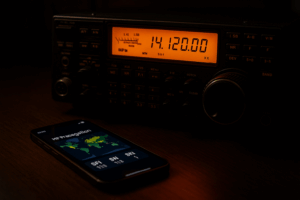

A portable antenna kit often starts with an attractive idea: carry less, set up faster, and still make useful contacts from a park, summit, campsite, hotel room, or emergency exercise site. The trouble is that antennas do not shrink for free. When you reduce length, height, weight, or setup footprint, you usually pay somewhere else in efficiency, bandwidth, stability, or convenience.
The goal is not to find a miracle antenna. The goal is to build a small system whose limits you understand. A compact antenna kit becomes much more dependable when you treat it as a complete field station rather than as a single wire, whip, or matching box.
Start by defining what small actually means. For one operator, small may mean everything fits in a jacket pocket. For another, it may mean a two-pound pouch and a 20-foot telescoping mast strapped to a daypack. Useful measurements include packed length, total weight, setup footprint, number of parts, time to deploy, wind tolerance, and how easy the system is to repair. A lightweight antenna that requires a perfect tree, delicate adapters, and twenty minutes of untangling may not be small in the practical sense.
Next, match the antenna to the site before you match it to the radio. A wooded park, rocky summit, beach pullout, and hotel balcony are different problems. In trees, a center-fed wire or end-fed wire may be convenient. On open ground, a whip or compact vertical with radials may be more predictable. In public spaces, the safest antenna is often the one with fewer trip hazards, clearer line visibility, and a fast teardown plan.
For HF work, remember the five constraints that dominate compact antennas: length, height, efficiency, bandwidth, and time. A full-size antenna at a reasonable height is usually easier to make efficient than a short loaded antenna. But a full-size wire may require supports you do not have. A whip may be faster to deploy, but it needs a serious return path. A tuner may produce an acceptable SWR, but it does not make a short antenna radiate like a full-size one.
That last point is worth repeating: low SWR is not proof of good radiation. SWR mainly tells you whether your transmitter sees a load it can tolerate. The load may be a useful antenna, a lossy matching network, a poor counterpoise arrangement, or some combination of all three. Field measurements are valuable, but they must be interpreted as part of the whole system.
A practical compact kit often begins with one of three antenna families. The first is a center-fed wire, such as a dipole, inverted vee, or linked dipole. These can be efficient and simple when you have at least one safe support. A linked dipole for two or more bands is especially appealing because it keeps the matching problem straightforward, though it requires careful labeling and tuning in the same geometry you plan to use on the air.
The second family is end-fed and random-wire systems. These pack extremely well and are popular for good reason. However, they are not self-contained wires. An end-fed half-wave often uses a transformer, while a nonresonant random wire may use an unun and tuner, but both still need a return path. If you do not provide a counterpoise or manage the feed line intentionally, the coax shield, radio, power cable, operator, or nearby objects may become part of the antenna. Symptoms can include touchy SWR, unstable tuning, distorted transmitted audio, or interference with electronics.
The third family is compact verticals and whips. These are useful when trees are unavailable or when a small footprint matters. The common mistake is focusing on the whip and treating radials as optional accessories. For many HF verticals, the radial or counterpoise system is the other half of the antenna. A 17-foot whip is close to a quarter wave on 20 meters, but it is much shorter electrically on 40 meters. Loading coils and tuners can help achieve a match, but bandwidth narrows and losses become more important as the antenna becomes shorter.
Feed line deserves more respect in a small kit. On HF, a short length of lightweight coax may be a reasonable compromise for a park station. On VHF and UHF, feed-line loss can quickly become the difference between a workable and disappointing station. Connector choices also matter. BNC connectors are popular for portable HF because they are compact and quick. SMA connectors are common on handhelds and small radios, but they should be protected from strain. UHF-style connectors are rugged but bulky. Whatever you choose, reduce the number of odd adapters and carry only the ones you can identify quickly in poor light.
Mechanical details decide many field outcomes. Use cordage and strain relief so solder joints and binding posts do not carry the load. Bright line and small labels can prevent both tripping and lost parts. If you use trees, protect bark and avoid leaving anything behind. If you use a mast, think about wind before you think about maximum height. A lower antenna that stays up safely is better than a tall one that collapses or creates a public hazard.
Measurement should be simple and repeatable. Before cutting wire in the field, check the obvious: band links, adapters, coax, support height, nearby metal, wet ground, radial layout, and feed-line routing. Measure the antenna in the geometry you intend to operate. Change one variable at a time. If an analyzer or nanoVNA-style instrument shows the resonance is off, look for a trend rather than false precision. A reading taken with the wire on the ground or with your hand touching the connector may not represent operating conditions.
Keep a small antenna log. Note the date, location type, antenna used, height, radial count and length, feed-line length, band, mode, SWR trend, noise level, and any problems. Over several outings, this log becomes more valuable than memory. You may discover that one antenna is excellent for quick 20-meter park sessions, while another is better for longer 40-meter evening attempts. You may also find that an adapter, not the antenna design, caused repeated frustration.
Operating strategy is part of the antenna system. If a compact antenna is marginal on 40 meters at midday, try a more suitable band rather than assuming the antenna has failed. If your station is near a noisy parking area, moving thirty feet may help more than retuning. Search-and-pounce operating can be a diagnostic tool because strong stations give you quick feedback on whether you are being heard. Concise calling, careful listening, and realistic band selection often matter as much as another accessory in the pouch.
A good small-pack antenna kit is not the smallest possible collection of parts. It is the smallest collection that still lets you deploy safely, match the site, verify the setup, operate effectively, and fix common failures. Build it around repeatable workflows, not hope.
For a deeper, field-focused treatment of these decisions, Portable Antennas That Pack Small by Duarte Lickfold expands this approach into a full guide covering compact wires, end-fed systems, whips, verticals, supports, measurement, troubleshooting, and practical operating strategy for licensed amateur radio operators.
Explore the Book
Continue learning with Portable Antennas That Pack Small by Duarte Lickfold, published by Lickfold Digital Publishers.