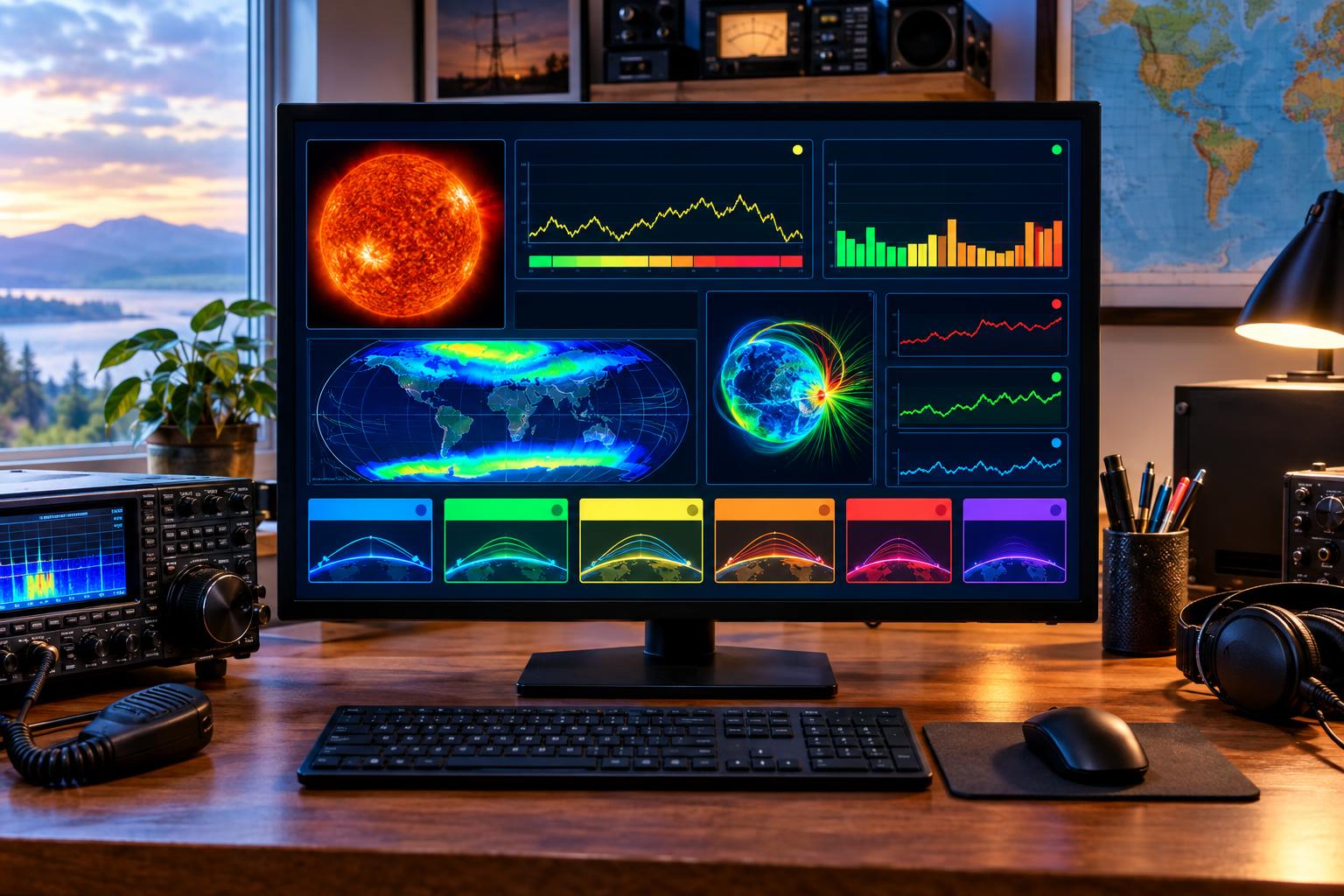

A useful SWPC HF propagation dashboard does not need to be fancy. For amateur radio operators, the goal is simple: put the right live space-weather clues on one shack screen so you can choose a band, protect a net schedule, and decide when a DX opening is worth chasing. NOAA’s Space Weather Prediction Center publishes machine-readable and plain-text feeds that can be checked directly from a browser, displayed on a small monitor, or pulled into a local dashboard.
The most practical screen for HF operating combines three things: solar flux for the ionization trend, Kp for geomagnetic disturbance, and the short-term NOAA risk outlook for radio blackouts, radiation storms, and geomagnetic storms. Used together, those feeds will not guarantee a contact, but they can keep you from treating every quiet band as an antenna problem or every good opening as random luck.
What to Put on the Shack Screen
A dashboard for HF nets and DX should answer four operating questions quickly:
- Is the ionosphere generally supportive of higher HF bands? Use the solar flux outlook and recent trend.
- Is geomagnetic activity likely to disturb paths? Use Kp and the planetary K-index forecast.
- Is there a short-term space-weather hazard? Use the three-day solar and geomagnetic prediction text.
- What does an experienced ham-radio interpretation say this week? Compare the NOAA data with a current amateur-radio summary such as the ARRL Solar Update.
The best dashboard is not a wall of numbers. It is a compact operating aid: SFI trend, Kp now and forecast, three-day risk language, UTC time, and a short personal note such as “40 meters primary, 80 meters backup” or “try 15 meters before sunset.”
The Core Feeds to Use
27-Day Solar Flux and Geomagnetic Outlook
The NOAA SWPC 27-day outlook is useful for planning ahead. It typically presents expected 10.7 cm solar radio flux and geomagnetic activity indicators over the coming solar rotation. The 10.7 cm flux, usually called SFI by operators, is measured near 2800 MHz and is widely used as a proxy for solar extreme ultraviolet activity that helps ionize the F region of the ionosphere.
For HF, higher SFI often supports higher maximum usable frequencies, especially on daylight paths. That can make 20, 17, 15, 12, and 10 meters more promising. But SFI is not a band-opening switch. Time of day, season, latitude, path length, solar events, and absorption still matter. A rising SFI with quiet geomagnetic conditions is usually more encouraging than a high SFI paired with stormy Kp.
Three-Day Solar and Geomagnetic Prediction
The NOAA SWPC three-day solar and geomagnetic predictions give a practical short-range risk view. For operating, this is where you look before a scheduled HF net, contest weekend, emergency exercise, or planned DX session. It can show whether NOAA expects increased chances of radio blackouts, solar radiation storms, or geomagnetic storms.
For hams, the value is not merely knowing that space weather is active. It is knowing when to prepare alternatives. If geomagnetic storm risk rises, you may want to shift a regional net toward lower bands, identify a near-vertical incidence skywave option, or prepare VHF/UHF repeaters and internet-assisted coordination as backups where appropriate.
Planetary K-Index Forecast JSON
The NOAA planetary K-index forecast JSON is ideal for dashboards because it is structured data. Kp is a 0 to 9 planetary index describing geomagnetic disturbance in three-hour intervals. Low Kp generally favors more stable HF paths. Elevated Kp can degrade polar and high-latitude paths, increase absorption, produce fluttery signals, and make DX unpredictable. Very high geomagnetic activity may also bring auroral propagation on VHF while damaging ordinary HF reliability.
For a shack display, show the Kp forecast by UTC block. That matters because a station planning a 0100Z net and another station chasing long-path DX at 1400Z may face different geomagnetic conditions.
ARRL Solar Update for Amateur-Radio Context
NOAA gives the primary data. A ham-focused interpretation can help you connect those numbers to bands and operating behavior. The ARRL Solar Update is a useful companion because it discusses solar and geomagnetic conditions in the language of amateur radio. Treat it as context, not as a substitute for checking live feeds before an operating commitment.
How to Interpret SFI Without Overreading It
SFI is often quoted as one number, but the trend matters. A dashboard should show current value if available from your chosen source, plus the 27-day outlook. In general:
- Lower SFI often means 10 and 12 meters are less reliable, while 20 and 40 meters carry more of the DX load.
- Moderate SFI can support dependable 20 meters and periodic openings on 17 and 15 meters.
- Higher SFI can make 15, 12, and 10 meters more interesting, especially on daylight paths and during favorable seasons.
Do not use SFI alone to declare a band “open” or “dead.” A high solar flux number during disturbed geomagnetic conditions may still produce poor polar paths and noisy, unstable signals. Conversely, a modest SFI can still support good regional and mid-distance contacts on 40, 30, and 20 meters.
How to Use Kp for Band Choice
Kp is one of the fastest numbers to act on. A simplified operating interpretation looks like this:
- Kp 0–2: Generally quiet geomagnetic conditions. Good time to try marginal DX paths and higher bands if SFI, daylight, and season support them.
- Kp 3–4: Unsettled to active. Expect more variability, especially over polar or high-latitude routes. Keep backup bands ready.
- Kp 5 or higher: Geomagnetic storm levels. HF may be degraded, particularly on polar paths. Lower bands, regional paths, and non-HF backups may become more important.
These are not hard rules. A station in Arizona working the Caribbean and a station in Maine trying to work northern Europe may experience the same Kp very differently. Your dashboard should help you ask, “What path am I trying to use?” not just “Is the number good?”
A Practical Dashboard Layout
For a single shack monitor or browser tab, arrange the information in this order:
- UTC clock at the top. Space-weather products and logs are easier to compare in UTC.
- Current and forecast Kp in three-hour blocks, with simple color coding if your display allows it.
- 27-day SFI outlook with today, tomorrow, and the next few days emphasized.
- Three-day NOAA risk summary for radio blackout, radiation storm, and geomagnetic storm potential.
- Personal operating notes for your nets, favorite DX paths, and backup bands.
If you prefer a low-effort approach, bookmark the NOAA text feeds and open them in separate browser tabs. If you enjoy tinkering, a local script can fetch the JSON and text products and render them on a Raspberry Pi, spare laptop, or shack computer. Avoid building an operating plan around a feed you cannot read quickly under time pressure.
Example: Protecting an Evening HF Net
Suppose your club runs a regional evening net. Your usual primary band is 75 meters, with 40 meters as an early-evening option. Before net time, check the three-day prediction and Kp forecast. If Kp is quiet and there is no concerning geomagnetic language, proceed with the normal plan. If Kp is elevated or forecast to rise during the net window, prepare for shorter skip, deeper fading, or more noise. Net control can announce a backup frequency or alternate band according to the club’s established plan and applicable band privileges.
For regional coverage, do not automatically move higher just because solar flux is strong. In the evening, 75 and 40 meters may still be more appropriate than 20 meters for close-in coverage. SFI helps you understand the broader ionosphere; the net’s required distance determines the practical band.
Example: Planning a DX Session
For DX, combine SFI, Kp, path, and daylight. If the 27-day outlook suggests improved solar flux and the Kp forecast is quiet, put more effort into 15, 12, and 10 meters during daylight and gray-line opportunities. If Kp is unsettled, favor paths that do not cross disturbed polar regions and be ready for rapid changes. If a three-day product warns of elevated geomagnetic storm potential, do not cancel all plans automatically, but keep expectations flexible and log the conditions alongside your contacts.
Digital weak-signal modes may produce decodes when voice sounds poor, but they do not repeal propagation. If the path is heavily absorbed or geomagnetically disrupted, changing mode can help only within limits.
Common Mistakes to Avoid
- Using one number as a verdict. SFI, Kp, and NOAA risk language must be read together.
- Ignoring UTC. A “tomorrow” forecast may not align with your local evening unless you check the time basis.
- Confusing solar flux with solar flares. SFI describes radio flux; flare-related radio blackouts are a separate short-term issue.
- Forgetting geography. High-latitude and polar paths are usually more sensitive to geomagnetic disturbance.
- Blaming the antenna too soon. If multiple bands suddenly degrade during disturbed conditions, check space weather before rebuilding the station.
Safety and Regulatory Caveats
Space-weather awareness does not change licensing rules. Operate only within the privileges, power limits, band allocations, and mode restrictions that apply to your license and jurisdiction. Maintain RF exposure compliance, use safe grounding and lightning practices, and do not rely on a single HF path for critical safety communications. For public-service events and emergency exercises, build redundant communications plans that include local repeaters, simplex, commercial communications where appropriate, and written procedures.
FAQs
Is a higher SFI always better for HF?
Not always. Higher SFI often improves higher-band potential, but geomagnetic storms, absorption, time of day, and path geometry can still make conditions poor.
What Kp level should make me change plans?
For routine operating, Kp 0–2 is generally favorable and Kp 5 or higher deserves caution. For scheduled nets or rare DX, even Kp 3–4 may justify having backup bands and alternate paths ready.
Can the SWPC dashboard predict exactly when 10 meters will open?
No. It can show whether conditions are favorable, but actual openings depend on path, daylight, season, antennas, noise, and activity on the band.
Should I still listen if the forecast looks bad?
Yes. Forecasts guide expectations; they do not replace listening. Some excellent contacts happen during brief openings in otherwise poor conditions.
Key Takeaways
- A practical SWPC HF propagation dashboard should show SFI outlook, Kp forecast, three-day risk, and UTC time.
- Use SFI to judge higher-band potential, but never without checking geomagnetic conditions.
- Use Kp to anticipate disturbed paths, especially for polar DX and scheduled HF nets.
- Use NOAA feeds for primary data and ham-radio summaries for operating context.
- Plan backup bands before the net or DX window, not after conditions collapse.