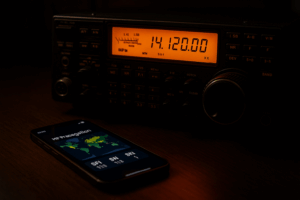

A bright streak on the waterfall is one of the most exciting sights in VHF weak-signal operating. For a fraction of a second, a meteor trail becomes a usable reflector, and a distant station may suddenly appear where ordinary propagation offered nothing. It is tempting to assume that if you can see bursts, you should be completing meteor scatter QSOs. In practice, many attempts fail even when the screen looks active.
The reason is simple: meteor scatter is not a continuous path. It is a probability game built from short bursts, station geometry, timing, mode behavior, antenna performance, and disciplined operating procedure. A trace may be too short, too distorted, too weak, off frequency, in the wrong sequence, or carrying only part of the needed exchange. Understanding those failure points is the first step toward turning more bursts into valid contacts.
Start with the difference between evidence of propagation and evidence of a QSO. A waterfall trace says energy reached your receiver. A partial decode says some structured information was recovered. A complete QSO requires the required on-air exchange and confirmation to be received over RF. Off-air chat, assumptions, and “I saw something at the right time” are not substitutes for the actual exchange. Conservative logging may feel slower, but it protects the meaning of a contact.
Timing is one of the most common problems. Modern meteor scatter operation often uses short transmit and receive periods, such as 15-second sequencing in MSK144. If both stations transmit during the same period, neither may hear the other. When answering a CQ, use the opposite sequence from the caller. If the caller is transmitting on even periods, answer on odd periods, and vice versa. Also verify your computer clock. A station that is several seconds off may see traces but miss decode opportunities because its software is listening and interpreting at the wrong time.
Mode choice matters as well. Meteor scatter favors digital modes that can make use of short, sudden bursts. MSK144 is designed around rapid frames and structured messages, which helps convert sub-second pings into decodes. Older modes such as FSK441 have historical importance and can still be understood technically, but current activity patterns often favor MSK144. The best mode is not only a technical decision; it is also a social one. You need to be where other operators are active, using the conventions they expect.
Audio setup can quietly ruin an otherwise capable station. Overdriven transmit audio may produce a wide or distorted signal that is harder to decode. Wrong sound-device selection can mean the software is listening to the laptop microphone instead of the radio interface. Operating-system audio enhancements, automatic gain processing, and unexpected sample-rate or level changes can create problems that look like propagation failure. For receive, aim for clean, undistorted audio and a stable waterfall. For transmit, use a dummy load where appropriate to confirm PTT, RF output, and clean drive before calling for real contacts.
Antenna and feed-line losses are especially important on VHF. On 6 meters, a modest horizontally polarized antenna can be forgiving enough for learning. On 2 meters, the link budget is tighter and losses become more punishing. Three dB of feed-line loss is not just an abstract number; it means roughly half your transmit power is lost before the antenna, and received burst strength is reduced on the way back to the receiver. That may be the difference between a clean decode and an undecodable trace. Good connectors, weatherproofing, appropriate coax, and sensible antenna placement often produce more useful improvement than immediately adding an amplifier.
Beam heading deserves practical thought. You do not point at the meteor shower radiant as though it were a station. For a point-to-point radio path, headings are generally based on the other station, the path midpoint, or an agreed operating strategy. Aiming errors may still allow occasional decodes, especially on broader antennas or shorter paths, but narrow 2-meter yagis can punish casual pointing. If you are scheduling a difficult path, agree in advance on frequency, sequence, message format, start and stop times, and beam headings.
Another common failure is advancing too early in the QSO sequence. Suppose you copy a partial report or a fragment that looks promising. It is natural to want to move ahead. Resist that urge. Repeat your current message until you receive complete, unambiguous information that tells you the state has changed. A typical progression includes CQ, answer with grid, report, R report, RRR, and 73. Real meteor scatter QSOs often involve repeated messages and delayed confirmation. Patience and state control are not optional niceties; they are how the contact gets completed correctly.
When troubleshooting, classify the symptom before changing settings. If there are no waterfall traces, check antenna path, coax, receiver gain, squelch, band activity, and local noise. If there are traces but no decodes, check mode, period length, clock accuracy, passband placement, audio quality, and frequency convention. If you decode others but receive no replies, examine transmit sequence, PTT, RF output, antenna heading, and whether you are calling in a practical window. If you get partial decodes only, the issue may be marginal propagation, low signal-to-noise ratio, timing, or an antenna/feed-line limitation.
Change one variable at a time. Meteor scatter already contains enough randomness; changing frequency, audio level, antenna direction, software settings, and message strategy all at once makes it impossible to learn. Keep notes on date, UTC time, band, frequency, mode, sequence, antenna heading, observed traces, decoded messages, and what you changed. Over several sessions, patterns emerge. You may discover that your station receives well but transmits poorly, that a local noise source appears at certain times, or that a particular path is simply too ambitious for your current setup.
Set realistic operating goals. A good beginner session might be receive-only monitoring during a known active period. A next step might be a measured block of 6-meter random calling with standard messages and a clear stop time. A difficult 2-meter grid attempt may require a schedule, accurate UTC timing, agreed sequence, careful antenna heading, and patience. Calling indefinitely is rarely a strategy. Defined goals and stop rules reduce fatigue and make your results easier to evaluate.
Most importantly, treat meteor scatter success as the product of repeatable habits rather than one magic setting. Accurate time, clean audio, correct sequence, suitable mode, horizontal weak-signal antenna practice, efficient feed line, conservative confirmation, and useful notes will do more for your operating than chasing rumors of a perfect configuration.
For operators who want a structured guide through these details, Meteor Scatter Contacts That Decode by Duarte Lickfold is a practical VHF field guide focused on 6 meters and 2 meters, MSK144, station setup, timing, QSO procedure, antennas, troubleshooting, and realistic operating strategy. It is written for licensed amateurs who want their meteor scatter contacts to be not just exciting, but properly decoded and correctly completed.
Explore the Book
Continue learning with Meteor Scatter Contacts That Decode by Duarte Lickfold, published by Lickfold Digital Publishers.