
A common beginner mistake in amateur-radio foxhunting is treating signal strength like a compass needle. The receiver gets louder, the bar graph climbs, and the team starts moving in that direction. Sometimes this works. Often it wastes time. In VHF and UHF radio direction finding, the strongest signal may be coming from the transmitter, a reflection off a building, a hillside, a sign, a fence, or even from receiver overload that has made direction nearly meaningless.
The better habit is to treat signal strength as one clue among several. It can tell you that something changed. It can suggest you are closer, more exposed to the signal, better aligned with the antenna pattern, or simply standing in a hot spot created by terrain and reflections. The task is not to worship the loudest reading. The task is to convert imperfect clues into better movement decisions.
Start with a simple hunt cycle: listen, measure, move, verify. Listen long enough to understand the signal and its timing. Measure with a consistent antenna, receiver setting, body position, and location. Move for a reason, not from excitement. Then verify whether the new position improved your information. This cycle prevents the classic foxhunt spiral where a team reacts to every stronger burst and ends up chasing ghosts.
The first practical improvement is to separate bearing quality from signal strength. A clean bearing is repeatable, taken away from obvious reflectors, and checked for front-to-back ambiguity. For example, if you use a handheld Yagi, rotate through a full circle rather than swinging only across the direction you already expect. Note the main peak, the reverse direction, any side peaks, and whether the result changes when you step sideways. If the same direction keeps appearing from a good location, confidence rises. If the peak jumps every few feet near cars, metal fencing, or buildings, label it as suspicious even if it is loud.
Mapping also keeps strength in perspective. A single bearing line can be seductive, especially when it feels precise. But most field bearings are better imagined as wedges of uncertainty. A rough bearing from a poor location might be a wide wedge. A repeatable bearing from an open hilltop might be narrower. When two or three reasonable wedges overlap, you have a more useful search area. When one loud reading points somewhere completely inconsistent with better geometry, do not ignore it, but do not let it take command. It may be a reflection, an overloaded receiver, or a clue that needs another measurement point.
Mobile foxhunting makes this discipline even more important. A vehicle can cover ground quickly, but it can also help you make bad decisions faster. The goal of the mobile phase is to improve geometry and access. Good stops beat constant motion. Pull over safely, take a bearing, label its confidence, and decide what the next stop should teach you. A loop route, a ridge road, or a set of radial roads may provide better information than simply driving toward a rising S-meter. If the best next action is to park near a legal access point and continue on foot, do that before the vehicle becomes a liability.
As you get closer, receiver overload becomes one of the biggest reasons the loudest signal lies. Many handheld receivers are not precision measuring instruments. Their bar graphs are relative indicators, and strong nearby transmitters can produce broad, full-scale responses. If every direction is strong, you have not found an all-directional fox. You have lost contrast. Add attenuation if you have it. Reduce coupling by switching to a less effective antenna, lowering the antenna, using body shielding, or carefully detuning where appropriate for your equipment and rules. The goal is not to make the signal pleasant. The goal is to restore differences you can compare.
Consistency matters when comparing strength. A reading taken with the antenna at shoulder height cannot be fairly compared with one taken near the ground unless you intended that test. A reading taken with 20 dB of attenuation is not directly comparable with a previous reading at 0 dB. Keep quick notes: location, antenna, attenuation, rough strength, bearing, and confidence. Even a few words on paper or in a phone can reveal that your best evidence points to an area, not to the last loud corner.
On foot, use patterns instead of wandering. In a park or campus, an expanding box can test whether the signal grows in a consistent direction. A perimeter cut can reveal which side of a bounded area is more promising. A trail sweep can keep you moving efficiently while pausing at selected openings for bearings. Lateral movement is especially useful. If a bearing shifts dramatically when you move sideways, you may be dealing with a reflection. If it remains stable from separated points, confidence improves.
The final close-in phase requires a different mindset. When you are within a few dozen yards, normal bearings may collapse. Pavilions, vehicles, culverts, trees, fences, and signposts can all create confusing local patterns. Instead of barging into objects or handling property, step back until contrast returns. Define the suspect area. Circle it if safe and permitted. Look for repeatable peaks and drops. Reduce the search sector gradually. Confirm conservatively, especially in public spaces or organized events with rules about what may be touched, opened, or disturbed.
When everything seems wrong, use a reset. Check the frequency. Check squelch. Check connectors. Remove unnecessary accessories. Simplify the antenna system. Add attenuation if the signal is too strong. Move away from metal. Wait through a full transmit cycle if the fox is intermittent. Ask whether you are defending a theory instead of observing the field. Fast recovery from bad clues is often more valuable than having perfect equipment.
The strongest signal is not the enemy. It is simply not the boss. Skilled foxhunters move faster because they collect cleaner evidence, label uncertainty honestly, and choose movement that improves the next decision. They understand that RF clues are shaped by antennas, terrain, reflections, overload, access, and timing. The hunt becomes less frantic and more repeatable.
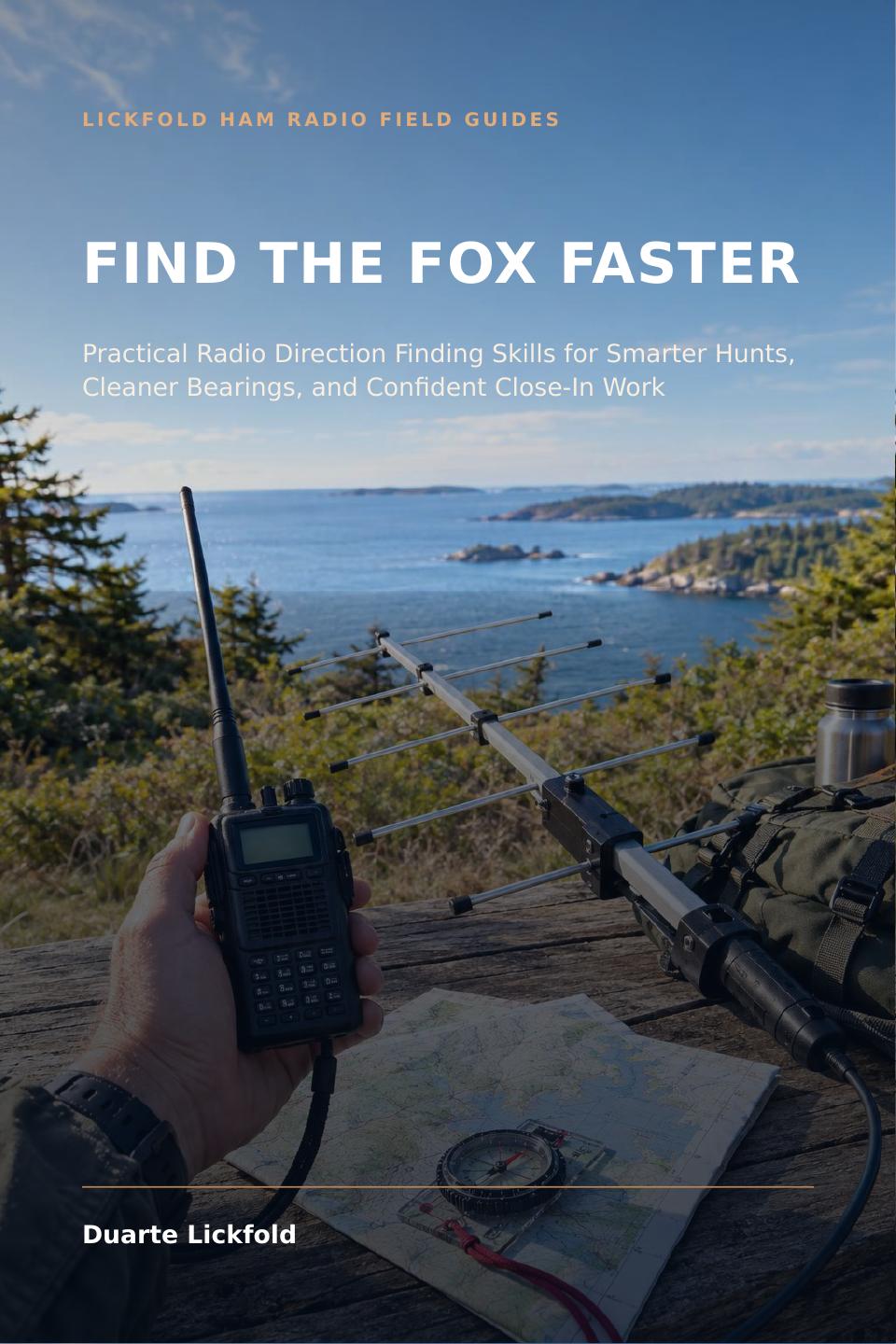
For operators who want a structured field guide to these habits, Find the Fox Faster by Duarte Lickfold is a practical next step. It covers RDF kits, directional antennas, bearing geometry, attenuation, mobile workflow, on-foot patterns, close-in methods, troubleshooting, and practice drills for amateur-radio foxhunts without promising magic or guaranteed results.
Explore the Book
Continue learning with Find the Fox Faster by Duarte Lickfold, published by Lickfold Digital Publishers.