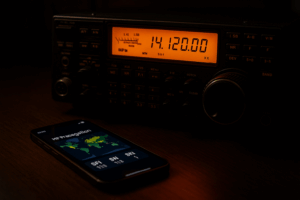

Five-watt DX is one of amateur radio’s most satisfying challenges because it forces the operator to respect the whole radio path. A 100-watt station can sometimes cover for a poor antenna, a noisy location, or a rushed call. A 5-watt station usually cannot. That does not mean QRP DX is impractical. It means every weak point matters: the antenna, feed line, timing, mode, noise floor, frequency accuracy, and the way you call.
The most useful mindset is to stop thinking of 5 watts as only a transmitter setting. What matters is the signal that is actually radiated in a useful direction and the other station’s ability to hear it at that moment. A watt wasted as feed-line loss, ground loss, common-mode current, or heat in a compact loading coil is not available to cross an ocean. Likewise, a watt transmitted on a band that is closed to your target region is not doing useful work.
Start with the receive side. Many low-power operators focus on being heard, but hearing comes first. If you cannot copy the DX station well enough to understand its call, rhythm, instructions, and operating frequency, you are not ready to transmit. Better receiving may mean using quieter locations, headphones, narrow filters, a cleaner power setup, or simply moving away from local electrical noise. In portable operation, a quiet park or lakeside site can sometimes outperform a home station with a bigger radio but a worse noise floor.
Next, look for the easiest losses to remove. A resonant or near-resonant wire in the clear is often a stronger QRP tool than a tiny compromise antenna with an excellent-looking SWR. SWR tells you about impedance matching at the measurement point; it does not prove that your signal is being radiated efficiently. An end-fed half-wave, dipole, inverted vee, or quarter-wave vertical can all work well when installed correctly. They can also disappoint when placed too low, fed with inappropriate line, missing adequate counterpoise or radials, or allowed to put RF where it does not belong.
For 20 meters and above, height and clear surroundings often pay back quickly. A simple wire high enough to form a useful radiation pattern can be a powerful low-power antenna. On lower bands, physical size and ground losses become harder to ignore. That does not make 40 meters useless for QRP DX, but it does mean the operator should be realistic about absorption, noise, and antenna compromise. When higher bands such as 17, 15, 12, or 10 meters are supported by propagation, they can be extremely valuable because they may offer lower noise and efficient antenna dimensions.
Band choice is where many QRP attempts are won or lost before the first call. A 5-watt signal should be sent when the path is likely to support it. Learn the broad personalities of the bands. Twenty meters is often the workhorse for daytime and transition-period DX. Seventeen and fifteen meters can be excellent when solar conditions cooperate. Ten meters can feel nearly impossible one day and effortless the next when the band opens. Forty and thirty meters can be useful around darkness and transition periods, but noise and absorption must be considered.
A practical habit is to test the highest plausible open band first. If you are in North America trying for Europe during the day, do not automatically begin on 40 meters because it is familiar. Check 15, 17, and 20 meters as conditions allow. Listen for beacons, calling stations, contest activity, or digital-mode decodes from the target region. If the high band is open, your small signal may have a better chance there than on a lower band where your antenna is less efficient and the band noise is higher.
Mode choice is another margin decision. CW remains one of the strongest tools for QRP DX when the operator can send cleanly and copy accurately. Weak-signal digital modes can reveal openings that are marginal for voice and can be highly effective when audio levels, timing, and transmit drive are managed carefully. SSB is certainly possible at 5 watts, but it usually needs more path margin, a capable receiving station, and clean, intelligible audio. The right question is not which mode is best in general, but which mode fits the path, exchange, operator skill, and station capability right now.
When you do transmit, the quality of the call matters. Search-and-pounce is usually more productive than calling CQ into uncertain conditions. Listen long enough to understand the other station’s pattern. Are they working simplex or split? Are they answering by region? Do they prefer full calls or partial repeats? Are they moving steadily through a pileup, or are they struggling to copy weak callers? A single well-timed call is better than repeated calling over the station you want to work.
In pileups, QRP discipline becomes even more important. Protect the DX station’s transmit frequency. If the operation is split, confirm your transmit frequency before calling. Watch where the DX is listening by observing the stations being answered. If instructions exclude your region or call area, do not call. If the operator comes back with a partial call that is not yours, stay out unless it truly matches. Low power is not a license to be sloppy; it is a reason to be more accurate.
Portable operators should also treat setup speed and safety as part of performance. A station that takes too long to deploy may miss the opening. A wire that creates a public hazard is not acceptable, even if it radiates well. Before transmitting, confirm permission, weather, battery condition, fuse protection, cable routing, antenna support stability, and a clear teardown plan. A simple, repeatable configuration is often better than a more ambitious setup that introduces new failure points every outing.
Finally, measure progress honestly. Log unsuccessful listening periods and failed attempts, not just completed contacts. Record band, time, antenna, mode, signal reports, spots or decodes, and what you heard. Over several weeks, patterns emerge. Maybe your 40-meter attempts are mostly lost in noise, while 15 meters produces better results on certain afternoons. Maybe your digital reports look strong, but your SSB audio is weak. Maybe changing feed line or raising the antenna made a larger difference than changing radios.
QRP DX rewards patience, observation, and small improvements. Five watts is enough to make remarkable contacts, but not enough to ignore physics, timing, or etiquette. If you want a structured guide to building that skill set, Duarte Lickfold’s Worldwide DX under 5watts: A Practical QRP Field Guide to Propagation, Antennas, Timing, and Operating Skill for Long-Distance Contacts is designed for exactly that purpose: realistic low-power DX through better station efficiency, smarter operating windows, and disciplined on-air technique.
Explore the Book
Continue learning with Worldwide DX under 5watts by Duarte Lickfold, published by Lickfold Digital Publishers.