Description
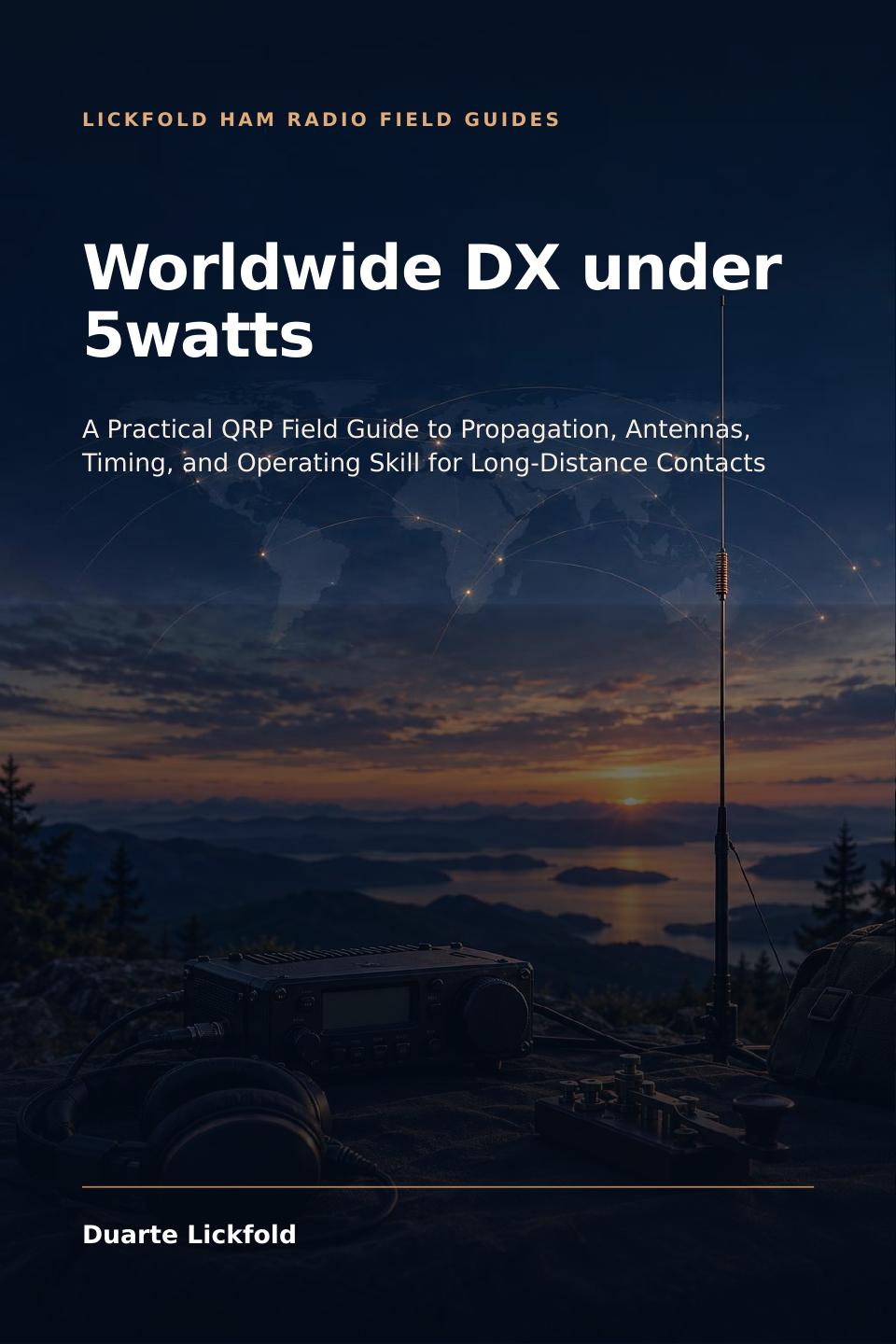
Five watts can cross oceans, but it rarely rewards guesswork. Worldwide DX under 5watts gives licensed amateur radio operators a technically conservative, field-ready approach to QRP DX: reduce losses, listen better, choose supported paths, and make each call count.
Duarte Lickfold treats low-power DX as a practical link-budget problem rather than a collection of miracle stories. You will learn why transmitter output is only one part of the signal chain, how feed-line and antenna choices can preserve or waste precious power, and why low SWR does not automatically mean efficient radiation. The book compares practical wire, vertical, loaded, and loop options with an emphasis on installation details, current distribution, radials, chokes, and site constraints.
Propagation receives equal attention. Instead of calling blindly, you will learn how to think through band personalities, daylight and darkness, gray line, solar indices, MUF and LUF, short path and long path, and seasonal tendencies. The book also covers mode selection for CW, weak-signal digital operation, and SSB, including clean audio, conservative drive levels, accurate timing, and realistic expectations.
On the operating side, Worldwide DX under 5watts focuses on search-and-pounce technique, pileup discipline, split operation, concise exchanges, frequency control, portable deployment, and post-session review. It includes checklists, scenarios, and a troubleshooting hierarchy to help you identify whether the problem is hearing, tuning, radiation, timing, calling, or confirmation.
This is not a promise that worldwide DX will happen on demand. It is a practical guide to improving your odds, measuring progress, and building a long-term QRP DX practice with 5 watts or less.
What You Will Learn
- How to think about QRP DX as a complete link-budget problem
- Why useful radiated signal matters more than transmitter output alone
- How antenna height, current distribution, ground loss, feed-line loss, and common-mode control affect 5-watt performance
- How to choose practical bands and operating windows using propagation clues
- When CW, weak-signal digital modes, RTTY, and SSB make sense for sub-5-watt DX
- How to call more effectively with better timing, frequency control, and concise exchanges
- How to approach pileups, split operation, partial calls, and DX etiquette at QRP power
- How contests, special events, POTA, SOTA, and other high-activity periods can improve low-power odds
- How to deploy a safe, lawful, fast portable QRP station
- How to log failures as well as contacts and use a 90-day improvement plan
Who This Book Is For
- Licensed amateur radio operators who want to pursue DX with 5 watts or less
- QRP operators who want more repeatable results and fewer random calling sessions
- Portable operators using parks, summits, campsites, or temporary field stations
- Hams choosing between CW, weak-signal digital modes, and SSB for low-power DX
- Operators who want to understand antennas, feed lines, radials, chokes, and losses in practical terms
- DXers who need better pileup discipline, split-operation habits, and timing
- Amateurs who want a realistic improvement plan rather than inflated QRP claims
Inside the Book
- 1. The Reality of Worldwide DX at Five Watts
- 2. Building an Efficient Sub-5-Watt Station
- 3. Antennas That Let Five Watts Travel
- 4. Propagation, Bands, and Timing for QRP DX
- 5. CW, Digital, and SSB: Choosing the Right Mode for the Contact
- 6. Operating Technique: Making a Small Signal Count
- 7. Pileups, Split Operation, and DX Etiquette at QRP Power
- 8. Contests, Special Events, POTA/SOTA, and Other High-Activity Opportunities
- 9. Portable QRP DX: Field Stations, Safety, and Fast Deployment
- 10. Measuring Progress, Troubleshooting, and Building a Long-Term QRP DX Practice
Format: EPUB eBook. Author: Duarte Lickfold. Publisher: Lickfold Digital Publishers.