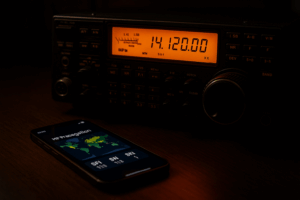

Five-watt operation is one of the most rewarding corners of amateur radio because it makes every part of the communication path matter. It can also be frustrating for exactly the same reason. When no one answers, it is tempting to blame the radio, the band, or the operator at the other end. Sometimes one of those is the problem. More often, QRP failure is the result of several small losses and weak choices stacking up until your signal is no longer readable.
A useful way to think about five watts is not “Can my radio make a contact?” but “Does this entire path support readable copy right now?” That path includes transmitter output, feed-line loss, tuner and matching losses, antenna efficiency, antenna pattern, propagation, receiving-station noise, operating mode, and your technique. If any one element is poor, five watts may still work. If three or four are poor at the same time, you are probably asking too much.
Start with the power difference, but do not obsess over it. Dropping from 100 watts to five watts is roughly a 13 dB reduction. In theory, that is a bit more than two 6 dB S-units. In practice, S-meters vary, noise floors vary, and readability depends on signal-to-noise ratio more than a meter reading. A five-watt signal can be perfectly workable on a quiet path with a good antenna and a suitable mode. It can also be lost completely in urban noise, poor timing, or an inefficient antenna system.
Before calling CQ, listen longer than feels necessary. Listening is not passive; it is evidence gathering. Are stations being heard on the band from the area you want to reach? Are they strong, weak, fluttery, or buried in noise? Are QRP, portable, or modest stations getting replies, or only high-power stations with large antennas? If the band sounds empty, check whether it is truly closed or simply quiet by tuning known activity areas, listening for beacons, checking spots with caution, or trying another band. Low power works best when you use paths that are already showing signs of life.
Next, inspect the antenna system with brutal honesty. Five watts at the transmitter is not always five watts usefully radiated. Feed-line loss, small loading coils, poor counterpoise connections, lossy matching networks, compromised height, and nearby objects can reduce the effective signal dramatically. A tuner may make the transmitter happy, but it does not turn a poor radiator into an efficient one. SWR is important for protecting equipment and avoiding foldback, yet a low SWR alone is not proof that the antenna is doing useful work.
If you are portable, antenna placement often matters more than tiny differences between transceivers. A linked dipole at a practical height, a well-deployed end-fed with appropriate counterpoise and common-mode control, or a vertical with an adequate ground system can outperform a convenient but lossy compromise. Also consider the desired path. A low horizontal antenna on 40 meters may be excellent for regional coverage under the right conditions, while a different height, band, or antenna pattern may be better for longer contacts.
Choose the band based on time and purpose. Forty meters can be a strong regional band, especially when conditions and noise cooperate, but it may be noisy or crowded. Twenty meters is often a practical long-haul QRP band during daylight and early evening openings. Higher bands such as 15, 12, and 10 meters can be excellent when open, but they are opportunistic. Lower bands such as 80 and 160 meters impose greater antenna and noise challenges. For local or scheduled goals, do not ignore VHF/UHF, repeaters, height, or satellites when they are more appropriate than HF QRP.
Mode choice is another major lever. SSB at five watts can be satisfying, but it needs a reasonably strong path, clean audio, conservative mic gain, and concise exchanges. CW often gives QRP a better chance because narrow filters, simple signaling, and human pattern recognition help readability. Good spacing and moderate speed beat sloppy speed. Weak-signal digital modes can complete structured contacts at low signal-to-noise ratios, but they demand accurate time, clean audio levels, stable equipment, and attention to duty cycle and heat. FM can work very well locally, but terrain, line of sight, antenna height, and repeater access dominate the result.
Operator technique can easily decide whether a marginal QSO succeeds. Pick a frequency that is actually clear from your location and, as far as you can tell, from likely receiving areas. Call with enough information to be useful but not so long that you waste openings. Use standard phonetics consistently. If your call includes November Zero Echo X-ray, do not drop the Echo when conditions get rough. In weak conditions, changing words unpredictably often makes copy worse, not better.
When answering someone else, match their rhythm. Do not send your call once into a pileup and assume failure means your station is inadequate. Listen for how the operator is taking callers: full calls, partial calls, regions, QRP stations, portable stations, or tail-end timing. If they return a partial, repair only what is needed. If they have “November Zero?” do not send a long biography. Send the missing pieces clearly and give them a chance to confirm.
Power and wiring deserve attention before the first transmission. A five-watt RF signal may require much more than five watts from the battery. For example, a radio drawing 2 amps at 12 volts is taking about 24 watts from the battery during transmit. Voltage sag can cause reduced output, distorted audio, erratic digital behavior, or shutdowns. Use appropriate fusing near the battery, sound connectors, correct polarity labeling, strain relief, and protection from moisture and abrasion. Many “bad propagation” days are actually weak battery or connector days in disguise.
Keep a log that records more than successful contacts. Note band, mode, antenna, approximate height, location, battery, noise level, time, reports, and serious failed attempts. Failed attempts are valuable data when they are specific. “Called 40-meter SSB for 20 minutes, high noise, no replies” teaches more than simply leaving the log blank. Over time, patterns emerge. You may discover that your 20-meter CW sessions are reliable, your digital setup works only when audio levels are adjusted carefully, or your favorite 40-meter portable antenna needs a better deployment method.
When troubleshooting, change one variable at a time when possible. Confirm that you can hear real signals. Check receiver settings, attenuation, RF gain, filters, mode, and volume. Verify supply voltage under transmit, not just at rest. Check SWR and tuner state conservatively. If available, test into a known load to separate transmitter problems from antenna-system problems. For digital modes, check time synchronization, audio drive, ALC behavior, and duty cycle. For SSB, listen for reports of distortion or low audio rather than assuming more mic gain will help.
Finally, know when five watts is the wrong choice. If the path is noisy, the antenna is severely compromised, the contact is urgent, or your goal requires high reliability at a specific time, QRP may not be appropriate. Raising power within your license privileges and safety obligations can be a reasonable operating decision. So can changing band, changing mode, improving the antenna, waiting for a better opening, or ending the session with useful notes instead of frustration.
The skill of QRP is not pretending that five watts can do anything. It is learning when five watts has a fair chance and then removing preventable obstacles. If you want a structured, practical guide to that process, Duarte Lickfold’s Five Watts, Better QSOs expands this checklist into a full field system covering station design, antennas, propagation, modes, portable setup, batteries, logging, troubleshooting, and a 30-day practice plan for more readable low-power contacts.
Explore the Book
Continue learning with Five Watts, Better QSOs by Duarte Lickfold, published by Lickfold Digital Publishers.