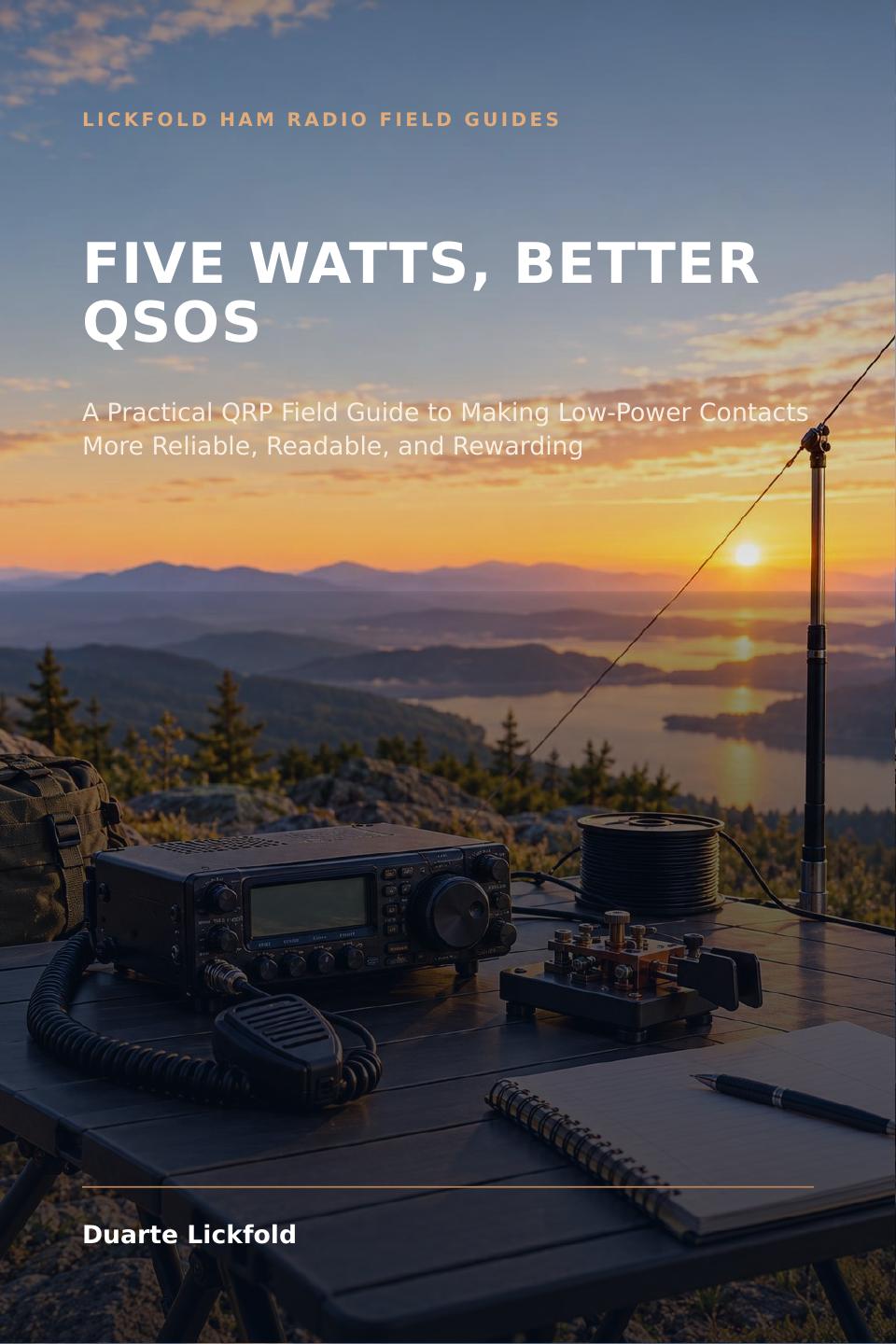
Description
Five-watt QRP can be deeply satisfying, but it is not magic. A low-power contact succeeds only when the radio, feed line, antenna, propagation path, receiving station, mode, and operator behavior all support readable copy. Five Watts, Better QSOs gives licensed amateur radio operators a practical way to improve that complete path.
Duarte Lickfold explains what five watts can and cannot do, including why the roughly 13 dB drop from 100 watts changes expectations but does not make contacts impossible. Instead of encouraging wishful operating, the book shows how to choose better moments, reduce preventable losses, and make disciplined decisions before calling CQ.
Inside, you will learn how to design a compact QRP station around efficiency, verify basic measurements, select antennas that let low power breathe, and understand why SWR alone does not prove useful radiation. You will compare HF bands, day and night timing, gray-line opportunities, NVIS possibilities, VHF/UHF options, and mode choices including SSB, CW, weak-signal digital, keyboard digital, and FM.
The guide also covers the human side of QRP: listening first, choosing a clear frequency, using standard phonetics, repairing partial copy, keeping exchanges concise, and knowing when to change band, mode, antenna, timing, or stop. Portable chapters address site selection, safe deployment, modular packing, setup and teardown workflow, battery runtime, fusing, wiring, connectors, and field electrical safety.
With logging methods, troubleshooting sequences, and a 30-day practice plan, Five Watts, Better QSOs helps you turn low-power operation into a repeatable skill rather than a lucky accident.
What You Will Learn
- How to judge when five-watt operation is realistic and when it is the wrong tool
- Why readability and signal-to-noise ratio matter more than S-meter expectations alone
- How to design a low-power station around the full operating chain, not just the transceiver
- How antenna, feed-line, matching, coil, and ground-return losses can shrink effective radiated power
- How to choose bands and operating times based on propagation evidence
- How SSB, CW, weak-signal digital, keyboard digital, and FM differ as QRP tools
- How to call, answer, use phonetics, repair partial copy, and keep QSOs concise
- How to plan safer, more repeatable portable QRP sessions
- How to estimate battery runtime and improve field electrical safety
- How to log completed contacts and failed attempts so each session teaches you something
- How to troubleshoot weak, unreadable, or missing signals in a disciplined order
- How to follow a 30-day practice plan focused on better copy, cleaner operation, and repeatable setup
Who This Book Is For
- Licensed amateur radio operators who already know basic operating and want to improve QRP results
- Portable operators planning park, trail, field, or compact station sessions
- Hams moving from 100-watt habits to five-watt decision-making
- Operators who want clearer SSB, CW, or digital low-power exchanges
- QRP enthusiasts who want fewer preventable failures from antennas, power, setup, or timing
- Home-station operators interested in compact, efficient low-power operating
Inside the Book
- What Five Watts Can—and Cannot—Do
- Designing the Five-Watt Station Around Efficiency
- Antennas That Let QRP Breathe
- Bands, Propagation, and Timing for Low Power
- Modes That Make Five Watts More Effective
- Calling, Answering, and Being Copied
- Portable QRP Without Preventable Failures
- Power, Batteries, and Field Electrical Safety
- Measuring, Logging, and Learning From Each QSO
- Troubleshooting Weak, Unreadable, or Missing Signals
- Building a Repeatable QRP Practice Plan
Format: EPUB eBook. Author: Duarte Lickfold. Publisher: Lickfold Digital Publishers.