
Join our Exclusive Ham Radio Newsletter
A small backyard does not make amateur radio impossible. It does, however, make antenna decisions less forgiving. When you have limited span, low supports, nearby buildings, fences, power lines, neighbors, and possibly HOA or lease restrictions, the antenna is no longer a single piece of hardware. It becomes a system: radiator, return path, feed line, matching device, support, safety clearance, and local noise environment.
The good news is that many small-space stations work well enough to make satisfying contacts. The less convenient truth is that compact antennas succeed when expectations are realistic and the installation is planned carefully. A short wire thrown into a tree may tune, but that does not mean it is radiating efficiently. A vertical may look simple, but without a decent radial or counterpoise plan, the coax shield and station wiring may become part of the antenna. A low SWR reading may mean your transmitter is happy, not that your signal is strong.
The first step is not choosing an antenna. It is measuring the space.
Walk the property with a tape measure, notebook, and camera. Mark the station location, possible feed-line entry, fence lines, usable support points, tree branches, roof edges, patio posts, and any place a temporary mast could stand safely. Note the height of supports, not just the horizontal distance between them. A 33-foot span at 8 feet high behaves differently from the same span at 25 feet. Also mark hazards: power lines, service drops, walkways, driveways, shared spaces, metal gutters, railings, sheds, and anything that could be touched by a falling wire or mast.
This sketch does not need to be artistic. It needs to be honest. Many poor antenna decisions happen because the operator designs for the yard they wish they had. A measured plan forces better choices. It may reveal that a 20-meter wire is possible, that a 40-meter wire would be heavily folded and compromised, or that a VHF/UHF vertical on a short mast would produce the quickest improvement.
Next, choose a first operating target. Trying to cover every band immediately is one of the most common small-lot mistakes. A weak all-band installation can be less satisfying than a simple antenna that performs reasonably well on one or two bands. For many small yards, 20 meters is a strong first HF target because the antenna dimensions are manageable and the band often supports useful contacts. Ten meters can be physically easy, though dependent on propagation. Forty meters can be very useful, but it usually demands more compromise in short yards. Eighty and 160 meters are possible for some operators, but they are rarely the easiest first choices in a tight space.
For VHF and UHF, the problem changes. The antennas are physically small, so height, clear view, and coax loss become more important. A dual-band vertical mounted as high as safely and lawfully possible, fed with reasonable low-loss coax, may outperform a more elaborate installation placed too low or fed through lossy cable. On 70 centimeters especially, coax choice and run length matter more than many new operators expect.
Once you have a target band, match the antenna type to the site. If you have two supports and a diagonal run, a compact dipole, inverted V, or bent wire may be practical. Bent ends are not automatically fatal, but they change the pattern and may affect tuning. If the feed point must be at one end, an end-fed half-wave or random wire may fit better, but it needs appropriate matching and a deliberate counterpoise or common-mode control strategy. Without that, the feed line often becomes an unintended radiator.
A vertical can be an excellent small-yard solution, especially where there is no room for a full horizontal wire. But a vertical is not just the upright element. The return path is part of the antenna. Ground-mounted verticals usually benefit from multiple on-ground or shallow radials, and the radials do not have to be perfectly symmetrical to be useful. More and better-connected radials often improve performance, especially on lower HF bands. Elevated verticals may use fewer radials, but those radials are typically more critical in length and placement, and they can create safety or access problems if people can touch them.
Low-visibility installations require another layer of thought. Low visibility is not the same as deception or unsafe improvisation. If you are in an HOA, rental, or shared building, permission and rules matter. Attic antennas, eave wires, removable patio masts, balcony whips, and flagpole-style verticals can all be useful in the right setting, but each has tradeoffs. Attics may contain wiring, ducting, foil-backed insulation, and high local noise. Balconies introduce shared-structure issues, falling-object risk, close human exposure, and metal railing coupling. Temporary systems reduce visual impact but must still be mechanically secure and electrically sane.
Matching is another area where small-space operators can save frustration. SWR is a measurement of impedance compatibility at a point in the system. It is not a direct measurement of radiation efficiency. A tuner can help the transmitter deliver power into a mismatch, but it cannot recover power already lost as heat in a coil, feed line, poor connection, or lossy return path. Internal tuners are convenient for moderate mismatches. External tuners may cover more range. Remote tuners placed near the antenna can reduce feed-line loss in some nonresonant systems. But every matching solution has limits in power, frequency range, duty cycle, and heating.
Common-mode current deserves special attention in compact installations. If RF is traveling on the outside of the coax shield, it can bring RF into the shack, disturb USB audio, affect speakers or routers, change the antenna pattern, and make tuning unstable. End-fed, random-wire, and vertical systems are especially prone to this when the return path is vague. A suitable choke in the right location can help, but it is not a substitute for radials or a counterpoise where those are needed.
Do not ignore receive noise. In dense neighborhoods, the limiting factor may not be your antenna’s ability to radiate; it may be your ability to hear. Switching power supplies, LED lighting, solar equipment, battery chargers, routers, appliances, and consumer electronics can raise the noise floor dramatically. Before replacing the antenna, keep a simple noise log. Record band, time, mode, S-meter reading, and what is running in the house. If safe and practical, compare normal operation with selected devices disconnected or with the receiver running from battery power. Restore suspected devices to confirm the noise returns. This methodical approach often beats random equipment swaps.
Finally, improve one thing at a time. Establish a day-one baseline: antenna layout, support heights, feed-line type and length, SWR readings, noise levels, weather conditions, and a few operating notes. Then change only one variable when possible. Add radials. Raise the feed point. Replace a lossy coax run. Improve weatherproofing. Add a choke. Move a power supply. If you change five things at once, you may get lucky, but you will not know what helped.
A small backyard station is a study in tradeoffs, not defeat. The best antenna is not always the one with the most bands printed on the box. It is the one that fits the property, the rules, the operating goal, the noise environment, and the safety requirements while wasting as little signal as possible.
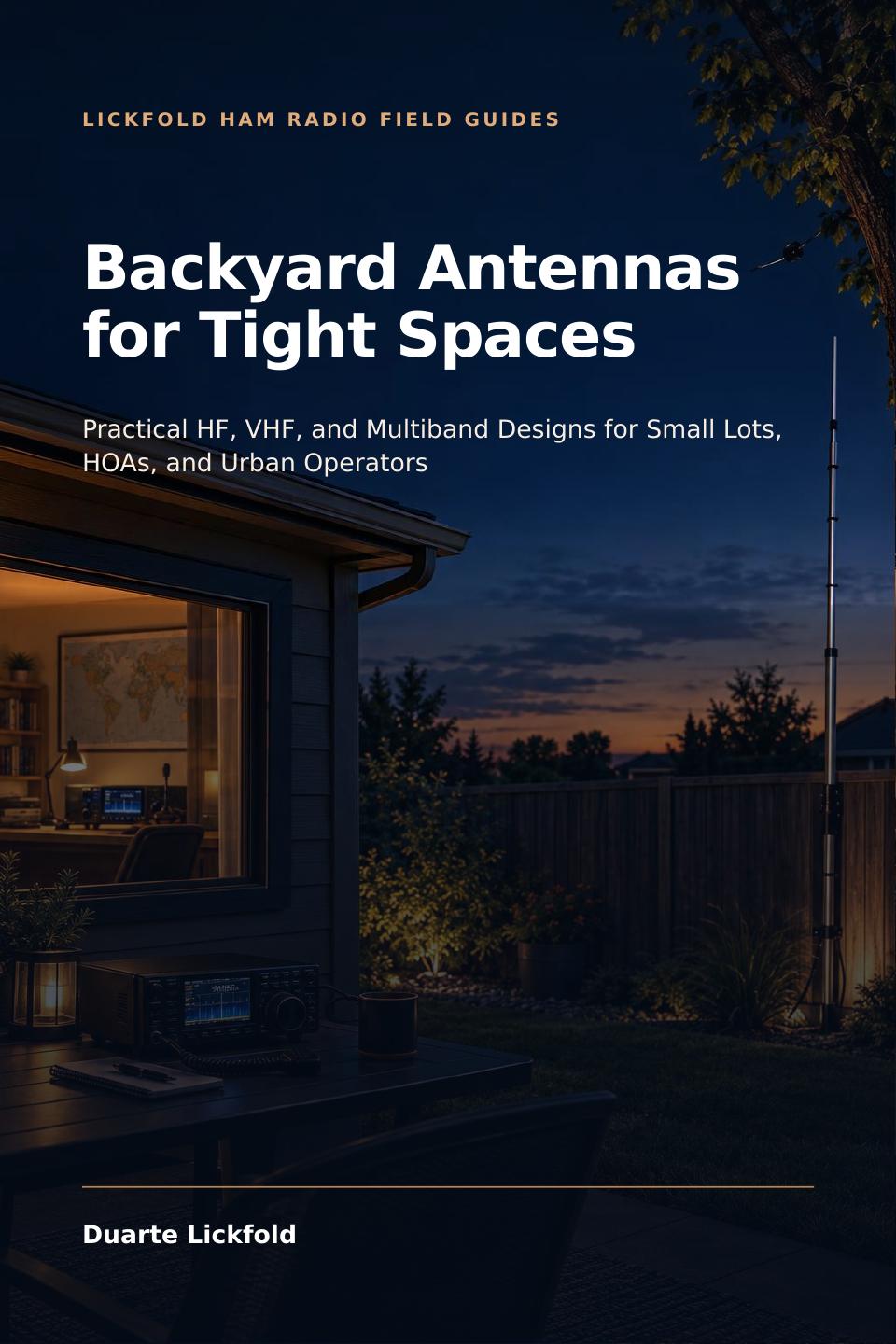
For operators who want a structured, practical guide to making those decisions, Backyard Antennas for Tight Spaces by Duarte Lickfold expands this process into complete HF, VHF, and multiband planning, installation, matching, low-visibility options, RFI troubleshooting, and three small-space build templates.
Explore the Book
Continue learning with Backyard Antennas for Tight Spaces by Duarte Lickfold, published by Lickfold Digital Publishers.
Check our selection of Hamradio e-books
-

Worldwide DX under 5watts
$9.97 -

Portable Antennas That Pack Small
$9.97 -

Tame Your First HF Dipole
$9.97 -

Backyard Antennas for Tight Spaces
$9.97 -

First POTA Activation Playbook
$9.97 -

Copy CW Through Real Band Noise
$9.97 -

Reading the HF Sky
$9.97 -

FT8 Without the Frustration
$9.97 -
Make Your Own RF Probe
$9.97 -
Sale!

Mastering APRS
Original price was: $59.99.$47.99Current price is: $47.99.
A Comprehensive Guide – ebook
⭐⭐⭐⭐⭐ -
Sale!

Mastering FT8
Original price was: $59.99.$47.99Current price is: $47.99.
A Comprehensive Guide to the Ultimate Digital Mode – ebook
⭐⭐⭐⭐⭐ -
Sale!

Stealth CB Antennas
Original price was: $59.99.$47.99Current price is: $47.99.
A Masterclass in Innovation and Disguise – ebook
⭐⭐⭐⭐⭐ -
Sale!

Ace Your Ham Radio Exam
Original price was: $59.99.$47.99Current price is: $47.99.
Technician, General, and Extra Class – ebook
⭐⭐⭐⭐⭐ -
Sale!

DMR for Hams
Original price was: $59.99.$47.99Current price is: $47.99.
The Ultimate Beginner’s Guide – ebook
⭐⭐⭐⭐⭐ -
Sale!

D-STAR, DMR & Fusion
Original price was: $59.99.$47.99Current price is: $47.99.
A Beginner’s Guide – ebook
⭐⭐⭐⭐⭐ -

Mastering the 6-Meter Band
$47.99
The Ultimate Guide – ebook
⭐⭐⭐⭐⭐ -
Sale!
Integrating Ham Radio with Modern Technology
Original price was: $59.99.$47.99Current price is: $47.99.
IoT, Raspberry Pi, and More – ebook
⭐⭐⭐⭐⭐ -
Sale!

D-STAR, DMR & Fusion
Original price was: $59.99.$47.99Current price is: $47.99.
Guia para Principantes – ebook
⭐⭐⭐⭐⭐ -
Sale!
Ham Radio for Preppers
Original price was: $59.99.$47.99Current price is: $47.99.
The Essential Survival Communications Guide – ebook
⭐⭐⭐⭐⭐ -
Sale!

Mastering Marine Radio
Original price was: $59.99.$47.99Current price is: $47.99.
A Sailor’s Guide to Confident Communication – ebook
⭐⭐⭐⭐⭐

Enter shop