Description
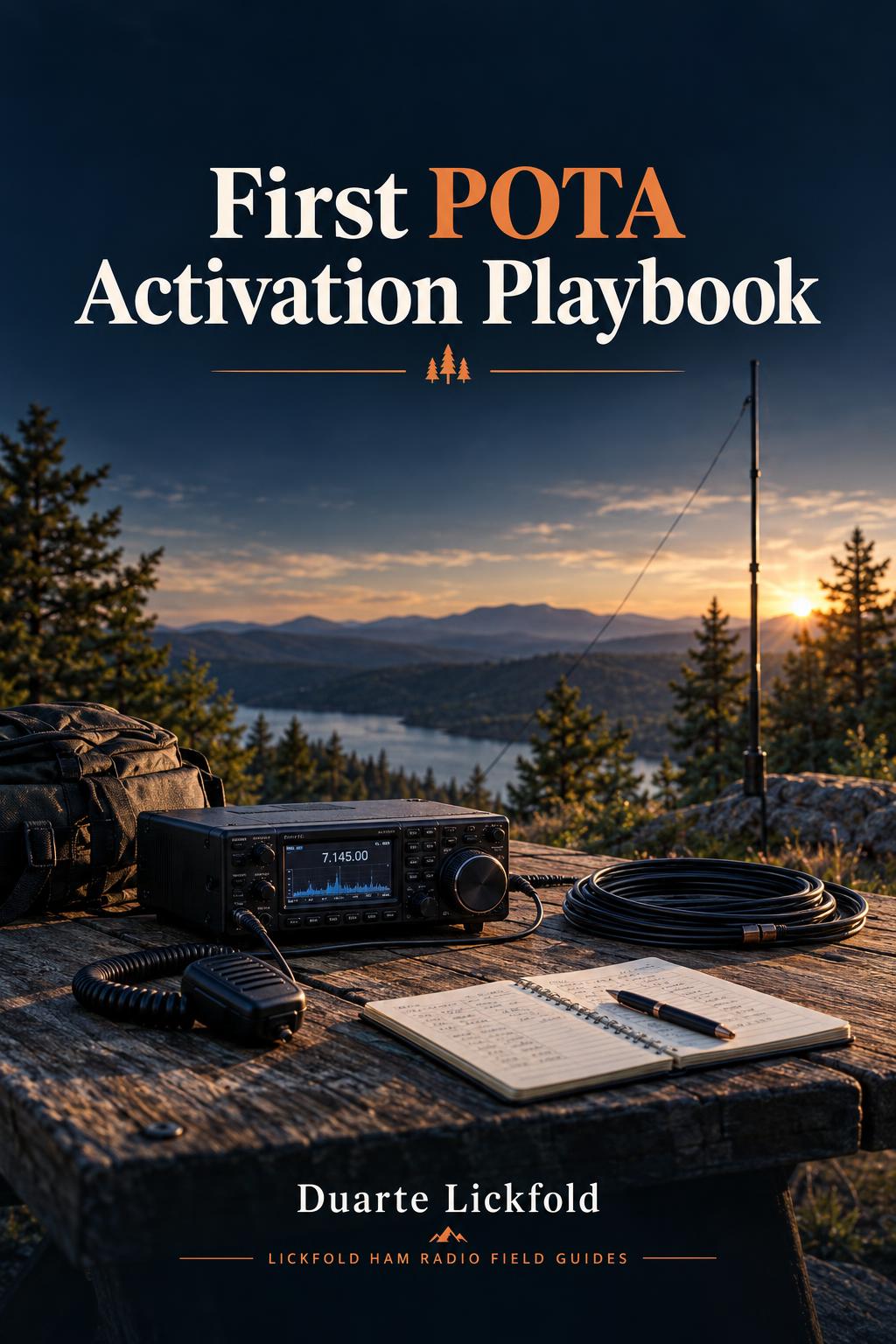
Your first Parks on the Air activation should not depend on luck, borrowed assumptions, or a last-minute gear pile. First POTA Activation Playbook gives licensed amateur radio operators a structured way to prepare for a first activation as a lawful, safe, accurately logged field operation.
Duarte Lickfold walks through the practical decisions that matter before you call CQ: choosing a suitable park, confirming the reference and operating area, checking access and rules, matching the station to your license privileges and stamina, and building radio, power, antenna, and logging into one workable field system.
Instead of treating portable operation as a contest for maximum contacts, this guide emphasizes what first activators can actually control: a conservative plan, a tested station, a reasonable operating window, safe antenna layout, backup logging, UTC discipline, and calm troubleshooting when conditions or equipment do not cooperate.
Inside, you will learn how to compare first-station profiles, estimate battery needs, choose antennas that fit real public spaces, conduct a dry run at home, make band and mode decisions, handle on-air procedure, avoid common logging mistakes, and perform an after-action review that improves your next outing.
The book is written for operators who want practical field competence over hype. It does not guarantee contacts or activation credit; it helps you reduce avoidable errors, operate courteously, preserve accurate records, follow current rules and park requirements, and turn your first POTA attempt into a repeatable personal system.
What You Will Learn
- How to define first-activation success beyond contact count
- How to choose a park, time, and operating position that reduce uncertainty
- How to think of radio, power, antenna, logging, and operator layout as one field system
- How to estimate battery needs using voltage, amp-hours, watt-hours, current, and duty cycle
- How to select practical first-activation antennas for real park conditions
- How to pack by function and identify single points of failure before leaving home
- How to run a 30-minute dry run and catch missing adapters, logging issues, and layout problems
- How to make first-day band and mode decisions without assuming propagation will cooperate
- How to call CQ, manage basic exchanges, handle duplicates, and change bands or modes cleanly
- How to keep UTC logs, preserve raw records, and prepare for current POTA submission requirements
- How to troubleshoot power, RF, procedure, and environmental problems in the field
- How to apply safe, courteous, low-impact operating practices in public spaces
- How to conduct an after-action review and improve one controlled variable at a time
Who This Book Is For
- Licensed amateur radio operators preparing for a first Parks on the Air activation
- New POTA activators who want realistic expectations and a step-by-step field plan
- Portable HF operators who need a practical approach to power, antennas, logging, and setup
- Technicians, Generals, and Extras who want to match an activation plan to their privileges and equipment
- Operators who prefer checklists, dry runs, and conservative troubleshooting over last-minute improvisation
- Hams who want to operate safely and courteously in public park spaces
Inside the Book
- 1. What a Successful First Activation Really Requires
- 2. Choosing the Right Park, Time, and Operating Plan
- 3. Station Architecture: Radio, Power, Antenna, and Logging as One System
- 4. First-Activation Antennas That Actually Fit the Field
- 5. Packing, Checklists, and the Dry Run at Home
- 6. Propagation, Band Choice, and Mode Strategy for the First Day
- 7. Setting Up and Operating On the Air
- 8. Logging, Validation, and After-Action Paperwork
- 9. Troubleshooting the Activation in Real Time
- 10. Safety, Courtesy, and Low-Impact Field Practice
- 11. Turning the First Activation Into a Repeatable System
Format: EPUB eBook. Author: Duarte Lickfold. Publisher: Lickfold Digital Publishers.