Description
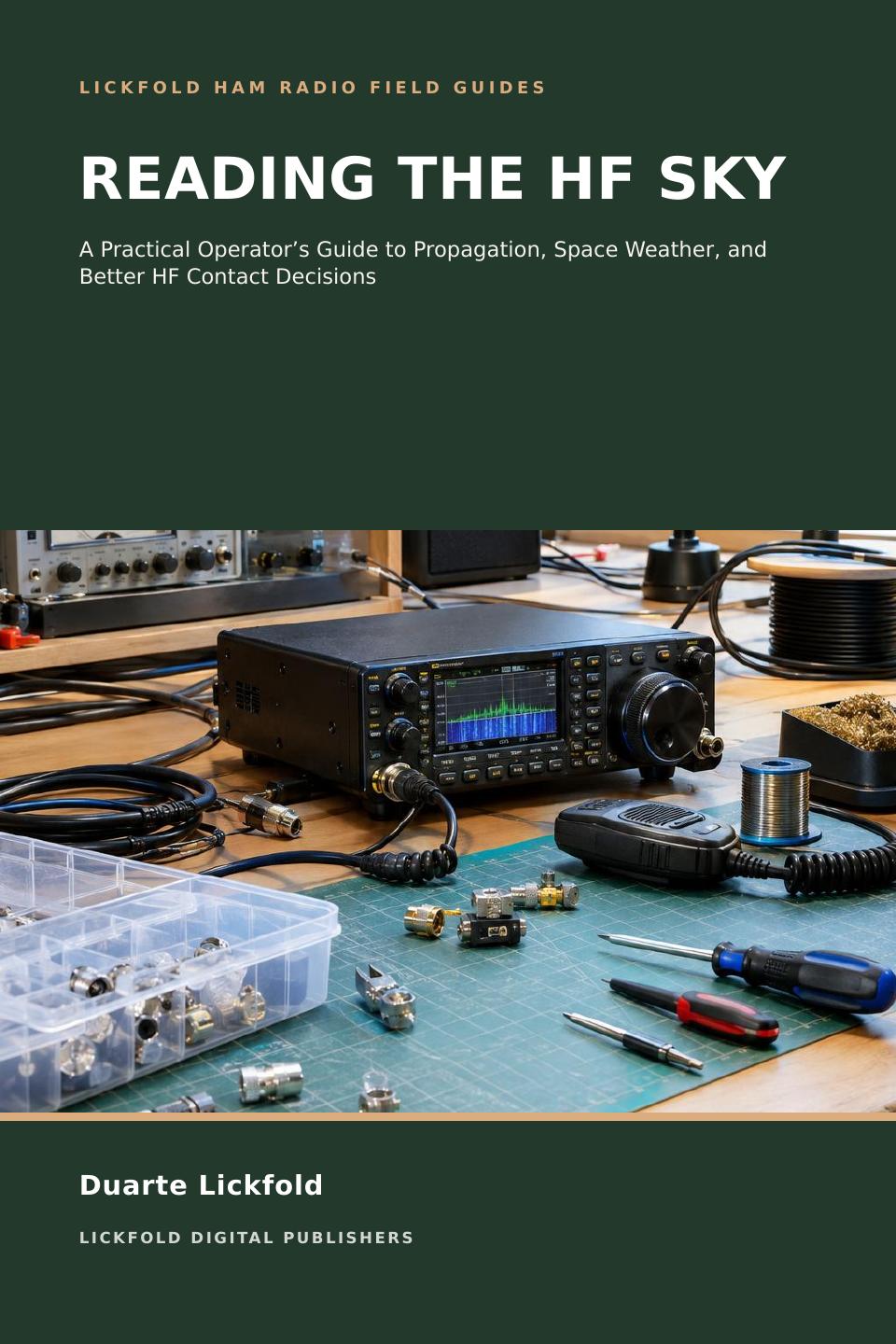
HF propagation is never just “open” or “closed.” A successful contact depends on path, frequency, time, solar and geomagnetic conditions, antenna pattern, noise, mode, signal margin, and whether anyone is actually listening. Reading the HF Sky gives operators a practical way to evaluate all of those factors without treating forecasts or solar numbers as magic answers.
Duarte Lickfold explains HF propagation as an operating decision system. You will learn how MUF, LUF, skip distance, daylight, darkness, seasonal changes, gray line, polar routes, and geomagnetic disturbance affect real operating choices. The book also shows how to use beacons, skimmers, weak-signal maps, spots, and your own receiver as evidence, while recognizing their limits.
Instead of promising guaranteed contacts, this guide teaches a repeatable way to ask better questions: Where is the path? What does the clock and season suggest? Which band is primary, which is the higher test, and which is the lower fallback? Is the path strong enough for SSB, CW, digital, or only a brief attempt? Are you propagation-limited, noise-limited, angle-limited, or simply activity-limited?
With grounded examples for regional nets, DX chasing, POTA/SOTA activations, emergency-practice drills, and casual operating, Reading the HF Sky helps you build a practical ten-minute forecasting workflow you can use before and during an HF session.
What You Will Learn
- How to think of an HF opening as a path-specific combination of frequency, signal margin, station capability, and activity
- How MUF, LUF, optimum working frequency, skip distance, and skip zones shape band choice
- How daylight, darkness, and seasonal patterns influence 80, 40, 30, 20, 15, and other HF bands
- How to interpret SFI, sunspot number, A index, K index, flares, CMEs, solar wind, and Bz without superstition
- How to use beacons, skimmers, WSPR, FT8-style reports, and spotting networks as evidence while understanding their limits
- How short path, long path, gray line, polar routes, bearings, and auroral effects change operating decisions
- How antenna height, takeoff angle, verticals, low wires, directional antennas, tuners, and receive noise affect usable contacts
- How mode, bandwidth, power, signal-to-noise ratio, and exchange style determine whether a path is truly usable
- How to diagnose noise, QSB, flutter, selective fading, interference, receiver overload, and crowding while operating
- How to build a repeatable ten-minute HF forecasting workflow with primary bands, backups, modes, antennas, and review times
Who This Book Is For
- Licensed amateur radio operators who want to understand HF propagation in practical operating terms
- DXers who want better band, path, and timing decisions without overreacting to single solar numbers
- POTA and SOTA operators planning limited-time activations from changing locations
- Net control stations and regional operators choosing realistic bands for coverage
- Contesters and casual operators who want to interpret beacons, skimmers, spots, and live signal behavior more intelligently
- Emergency-communications practitioners who need repeatable HF planning habits rather than optimistic assumptions
Inside the Book
- 1. The HF Sky as an Operating System
- 2. Frequency, Distance, and the Usable Window
- 3. The Daily Clock: Daylight, Darkness, and Seasonal Patterns
- 4. Solar Numbers Without Superstition
- 5. Maps, Beacons, Skimmers, and Real-Time Clues
- 6. Path Geometry: Short Path, Long Path, Gray Line, and Polar Routes
- 7. Matching Antennas and Takeoff Angles to the Sky
- 8. Modes, Power, and Signal Margins
- 9. Reading Noise, Fading, and Signal Behavior on the Air
- 10. Building a Repeatable HF Forecasting Workflow
Format: EPUB eBook. Author: Duarte Lickfold. Publisher: Lickfold Digital Publishers.