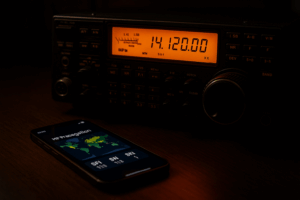

Join our Exclusive Ham Radio Newsletter
HF operators often ask one broad question before getting on the air: “Is the band open?” It is understandable, but it is not precise enough to guide a good operating decision. A band is not simply open or closed. It may be usable to one region and poor to another. It may support FT8 but not comfortable SSB. It may favor a low-angle DX antenna while leaving a regional net weak. It may sound empty because the path is poor, or because nobody is transmitting where you are listening.
A better question is: “Open enough for which path, on which band, with which mode, using my station, right now?” That question leads to a much more useful pre-operating routine. You do not need to become a space physicist to do this well. You need a consistent way to combine the clock, the target path, solar and geomagnetic clues, real-time observations, and your station’s strengths and weaknesses.
Start with the mission. Before looking at numbers or maps, define what you are trying to do. Are you trying to work Europe from the eastern United States on SSB? Check into a regional 80-meter net? Activate a park for two hours? Chase a station across a polar path? Practice emergency traffic within a few hundred miles? Each mission implies a different path length, takeoff angle, mode requirement, and tolerance for weak signals.
For example, a 40-meter regional net in the evening may need dependable medium-range coverage and good readability, not long-haul DX. A POTA activation may need quick contacts and enough callers to sustain activity. A DX attempt may accept weak copy, timing, repeats, and a narrower operating window. If you do not define the mission, every propagation clue looks equally important.
Next, use the clock and season as your baseline. Daylight and darkness shape HF before any solar index enters the picture. Lower bands such as 80 and 40 meters often become more useful after dark because D-region absorption drops, though noise may still be significant. Higher bands such as 15, 12, and 10 meters generally need enough ionization and the right path support, often favoring daylight or near-daylight routes when conditions cooperate. Twenty meters often serves as a bridge band, but even it changes character across morning, afternoon, evening, and season.
Think about both ends of the path, not just your local time. If you are in North Carolina and want the West Coast, ask what the daylight situation is at your station, at the other end, and along the route. If you want Europe near your sunset, consider whether the far end is already in darkness and whether the path is moving through a useful transition. For gray line possibilities, check both sunrise and sunset timing; gray line is an opportunity, not a guarantee.
Now choose a primary band, a higher test, and a lower fallback. This simple structure prevents random band hopping. If your baseline suggests 20 meters may be the best starting point for a daylight DX path, your higher test might be 17 or 15 meters, while your lower fallback might be 30 or 40 meters depending on mode and regulations. If you are aiming for regional evening coverage, 40 meters may be primary, with 80 as a lower fallback and 20 as a quick check for longer activity.
The rule of thumb is practical: move higher when lower bands seem burdened by absorption, noise, or crowding, and move lower when the upper edge of usable propagation seems marginal or signals are escaping. This is not a law; it is a decision aid. Always keep the path and mode in mind. In the United States, for instance, 30 meters is not an SSB fallback and must be used only within permitted modes and privileges.
Only after that should you read solar and geomagnetic information. Solar flux and sunspot number can suggest higher-band potential, but they do not prove a path is open. The K index gives recent geomagnetic disturbance context, while the A index summarizes a broader daily level. High-latitude and polar paths are usually more sensitive to geomagnetic disturbance than lower-latitude paths. A flare can produce daylight-side absorption, while CME-related geomagnetic effects arrive later and may disturb paths differently.
Avoid letting one number decide your whole session. High solar flux with unsettled geomagnetic conditions may be less useful for a sensitive path than moderate flux with quiet conditions. Conversely, a low-looking solar summary does not mean every lower-band or regional path is dead. Treat the numbers as evidence that adjusts expectations, not as permission or prohibition.
Then gather real-time clues. Listen first. Is the band noisy, quiet, crowded, or full of weak traces? Are signals steady, slowly fading, fluttery, or distorted? Check adjacent bands if you can. A quick comparison between 20 and 17 meters, or between 40 and 80 meters, may reveal whether you are near the upper or lower edge of the usable window.
Automated tools can help, but interpret them carefully. A beacon you hear proves that a signal from that beacon reached your receiver at that moment; it does not prove the reverse path, your antenna pattern, or SSB margin. Skimmer and weak-signal reports show that specific receiving stations decoded or detected specific signals. FT8 or WSPR activity may reveal a weak path that is not strong enough for casual voice. Spotting networks show activity, but they are biased by contests, rare stations, popular bands, and human attention.
Your receiver is also a diagnostic instrument. Separate signal strength from noise. A strong signal buried under local RFI is a different problem from a weak signal on a quiet band. Slow QSB may be workable with short transmissions and good timing. Fast flutter, selective fading, or watery audio may suggest an unstable or multipath-sensitive route, especially on disturbed or polar paths. Adjacent-channel splatter or receiver overload may require filtering, attenuation, RF gain adjustment, or a different slice of spectrum, not a propagation conclusion.
Finally, make a timed operating plan. For example: “Call on 20-meter SSB toward the Midwest for ten minutes, then test 17 meters if reports or signals suggest higher-band support, otherwise fall back to 40 meters. Recheck spots and receiver conditions every fifteen minutes.” A plan like this keeps you from abandoning a band too quickly or staying too long after evidence changes.
A simple log makes the process better over time. Record date, time, season, target region, bands tried, solar and geomagnetic context, antenna used, mode, what you heard, what worked, and what failed. After a few weeks, you will begin to see patterns specific to your station. You may discover that your low 40-meter wire is excellent for regional evening work but poor for certain DX angles, or that your noise floor, not propagation, is the main limit on one band.
The goal is not perfect prediction. HF will always surprise you. The goal is to replace guesswork with a repeatable decision process: define the mission, read the clock, check both ends of the path, interpret solar data conservatively, gather live evidence, match the antenna and mode to the likely path, and review on a schedule.
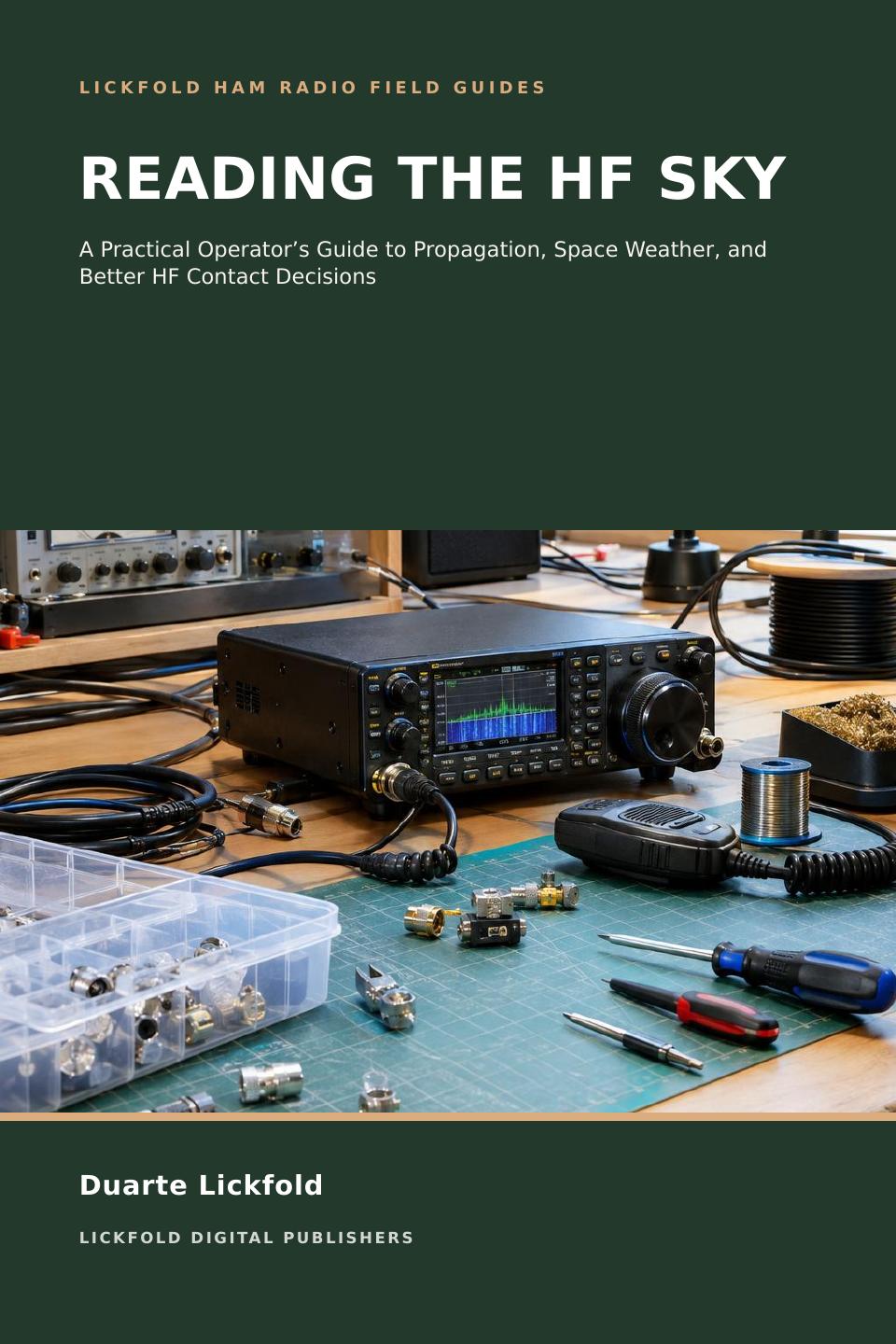
For operators who want a fuller field guide to this way of thinking, Reading the HF Sky by Duarte Lickfold expands the routine into a practical system covering propagation windows, solar numbers, real-time tools, path geometry, antennas, modes, noise diagnosis, and operating workflows for DXing, nets, POTA/SOTA, emergency practice, contests, and everyday HF contacts.
Explore the Book
Continue learning with Reading the HF Sky by Duarte Lickfold, published by Lickfold Digital Publishers.
Check our selection of Hamradio e-books
-
Worldwide DX under 5watts
$9.97 -

Portable Antennas That Pack Small
$9.97 -

Tame Your First HF Dipole
$9.97 -

Backyard Antennas for Tight Spaces
$9.97 -

First POTA Activation Playbook
$9.97 -

Copy CW Through Real Band Noise
$9.97 -
Reading the HF Sky
$9.97 -
FT8 Without the Frustration
$9.97 -
Make Your Own RF Probe
$9.97 -
Sale!

Mastering APRS
Original price was: $59.99.$47.99Current price is: $47.99.
A Comprehensive Guide – ebook
⭐⭐⭐⭐⭐ -
Sale!

Mastering FT8
Original price was: $59.99.$47.99Current price is: $47.99.
A Comprehensive Guide to the Ultimate Digital Mode – ebook
⭐⭐⭐⭐⭐ -
Sale!

Stealth CB Antennas
Original price was: $59.99.$47.99Current price is: $47.99.
A Masterclass in Innovation and Disguise – ebook
⭐⭐⭐⭐⭐ -
Sale!

Ace Your Ham Radio Exam
Original price was: $59.99.$47.99Current price is: $47.99.
Technician, General, and Extra Class – ebook
⭐⭐⭐⭐⭐ -
Sale!

DMR for Hams
Original price was: $59.99.$47.99Current price is: $47.99.
The Ultimate Beginner’s Guide – ebook
⭐⭐⭐⭐⭐ -
Sale!
D-STAR, DMR & Fusion
Original price was: $59.99.$47.99Current price is: $47.99.
A Beginner’s Guide – ebook
⭐⭐⭐⭐⭐ -

Mastering the 6-Meter Band
$47.99
The Ultimate Guide – ebook
⭐⭐⭐⭐⭐ -
Sale!
Integrating Ham Radio with Modern Technology
Original price was: $59.99.$47.99Current price is: $47.99.
IoT, Raspberry Pi, and More – ebook
⭐⭐⭐⭐⭐ -
Sale!
D-STAR, DMR & Fusion
Original price was: $59.99.$47.99Current price is: $47.99.
Guia para Principantes – ebook
⭐⭐⭐⭐⭐ -
Sale!
Ham Radio for Preppers
Original price was: $59.99.$47.99Current price is: $47.99.
The Essential Survival Communications Guide – ebook
⭐⭐⭐⭐⭐ -
Sale!

Mastering Marine Radio
Original price was: $59.99.$47.99Current price is: $47.99.
A Sailor’s Guide to Confident Communication – ebook
⭐⭐⭐⭐⭐

Enter shop