
Join our Exclusive Ham Radio Newsletter
A common beginner instinct in radio foxhunting is simple: drive or walk toward the place where the signal gets stronger. Sometimes that works. On an open field with a cooperative transmitter, clear line of sight, and a receiver that is not overloaded, signal strength can be a useful clue. But in real VHF/UHF hidden-transmitter hunts, the loudest direction is not always the right direction, and the strongest reading is not always the shortest route.
The faster approach is not to ignore signal strength. It is to stop treating it as proof. Good radio direction finding turns RF clues into movement decisions by combining bearings, signal comparisons, map reasoning, terrain awareness, and repeated verification. That discipline matters whether you are hunting from a vehicle across a county or closing in on a small transmitter hidden near a picnic shelter.
Signal strength is affected by more than distance. Buildings, hillsides, fences, signs, vehicles, wet foliage, and even your own body can change what the receiver hears. A reflected signal may arrive from a direction that is dramatically different from the transmitter’s actual location. A strong nearby transmitter may overload the front end of a handheld receiver, making the signal seem full-scale everywhere. Polarization can change the received strength when the hidden antenna is not aligned with yours. In urban areas, streets can act like RF corridors, making a signal sound better along one path even when the transmitter is off to the side.
That is why the first useful habit is to separate listening from deciding. When you hear the fox, resist the urge to immediately commit to a theory. Rotate the antenna slowly. Check the apparent peak or null. Turn 180 degrees to test front-to-back ambiguity. Move a short distance and try again. If the second observation agrees with the first, confidence improves. If it changes significantly, you have learned something just as valuable: the site may be reflective, overloaded, or poorly suited for a decision.
A bearing should be treated as an estimate, not a laser line. On a map, it is more honest to imagine a wedge of uncertainty than a perfect line. A clean bearing from an open hilltop with repeated agreement deserves more trust than a hurried reading beside a metal fence, shopping center, or parked vehicle. Labeling bearings mentally as high, medium, or low confidence keeps you from defending a bad clue just because it was the first one you wrote down.
Geometry also matters. Two bearings that cross at a sharp angle can give a useful area of interest. Two bearings that meet at a shallow angle may create a long, vague overlap. A third bearing can help, but only if it is taken from a meaningfully different place and under conditions you understand. If two reasonable bearings overlap near a park entrance and a third line points far away from a downtown street canyon, the odd line may be multipath rather than a revelation.
Mobile foxhunting adds another temptation: chasing every stronger reading. The vehicle is best used to cover distance, improve geometry, and find legal access. It is not a magic arrow. A disciplined team may stop at a ridge, take a bearing, drive to a second road with a better crossing angle, take another bearing, and then choose a parking point that supports a safe on-foot search. That is often faster than spiraling through streets because the S-meter climbed for a moment.
If you are hunting alone, keep vehicle safety separate from radio work. Stop before taking handheld bearings. Avoid antenna handling that distracts from driving. If you have a team, assign clear roles: driver, navigator, and radio operator. The driver’s job is driving, not interpreting the signal. This simple boundary prevents unsafe improvisation and usually improves the quality of the hunt.
On foot, a stronger signal still needs context. A good pedestrian search uses deliberate patterns. An expanding box can test a suspected block or field. A trail sweep works in parks where access is limited to paths. A perimeter cut helps determine whether the fox is inside or outside a boundary. A contour walk can be useful where hills and ridges shape coverage. A sector search narrows a probable area without wandering randomly.
The key is to pause at useful points rather than constantly swinging the antenna while walking. Walking trends can be helpful, but clean bearings usually come from controlled stops. Pick a location away from obvious reflectors when possible. Hold the antenna consistently. Keep the receiver settings stable. If the transmitter is intermittent, wait through enough of the transmit cycle to compare fairly. Log where you last heard it and where you last had a good bearing, not just where it sounded loudest.
As you get close, the rules change again. Full-scale readings are not directional evidence. When the receiver is saturated, the antenna pattern may appear to disappear. At this stage, the solution is to reduce coupling and restore contrast. Add attenuation if you have it. Switch to a less efficient antenna. Lower the antenna height. Use body shielding carefully. In some receive-only situations, operators may remove an antenna or detune cautiously, but equipment safety and transmit prevention must be respected.
A practical close-in method is to define the suspect area, step back until you regain contrast, and then circle the object or zone. Do not poke, climb, open, enter, or disturb property. Instead, compare repeatable peaks and drops from several positions. Slice the area into smaller sectors only when the evidence repeats. Around shelters, vehicles, signposts, trees, culverts, or fences, a second confirming clue is better than one dramatic meter jump.
When the evidence becomes confusing, do a reset rather than arguing with the signal. Check frequency, squelch, attenuation, connectors, batteries, and antenna orientation. Simplify the setup if possible. Move away from metal. Wait for a complete transmission. Change one variable at a time. A two-minute reset can save twenty minutes of chasing a reflection.
The deeper lesson is that fast foxhunting is not reckless foxhunting. It is measured, skeptical, and efficient. The best hunters build a chain of clues: a detection, a bearing, a second bearing with better geometry, a route decision, a pedestrian pattern, a close-in reduction in receiver coupling, and a conservative confirmation. Each step can be imperfect, but the process protects you from overcommitting to the wrong clue.
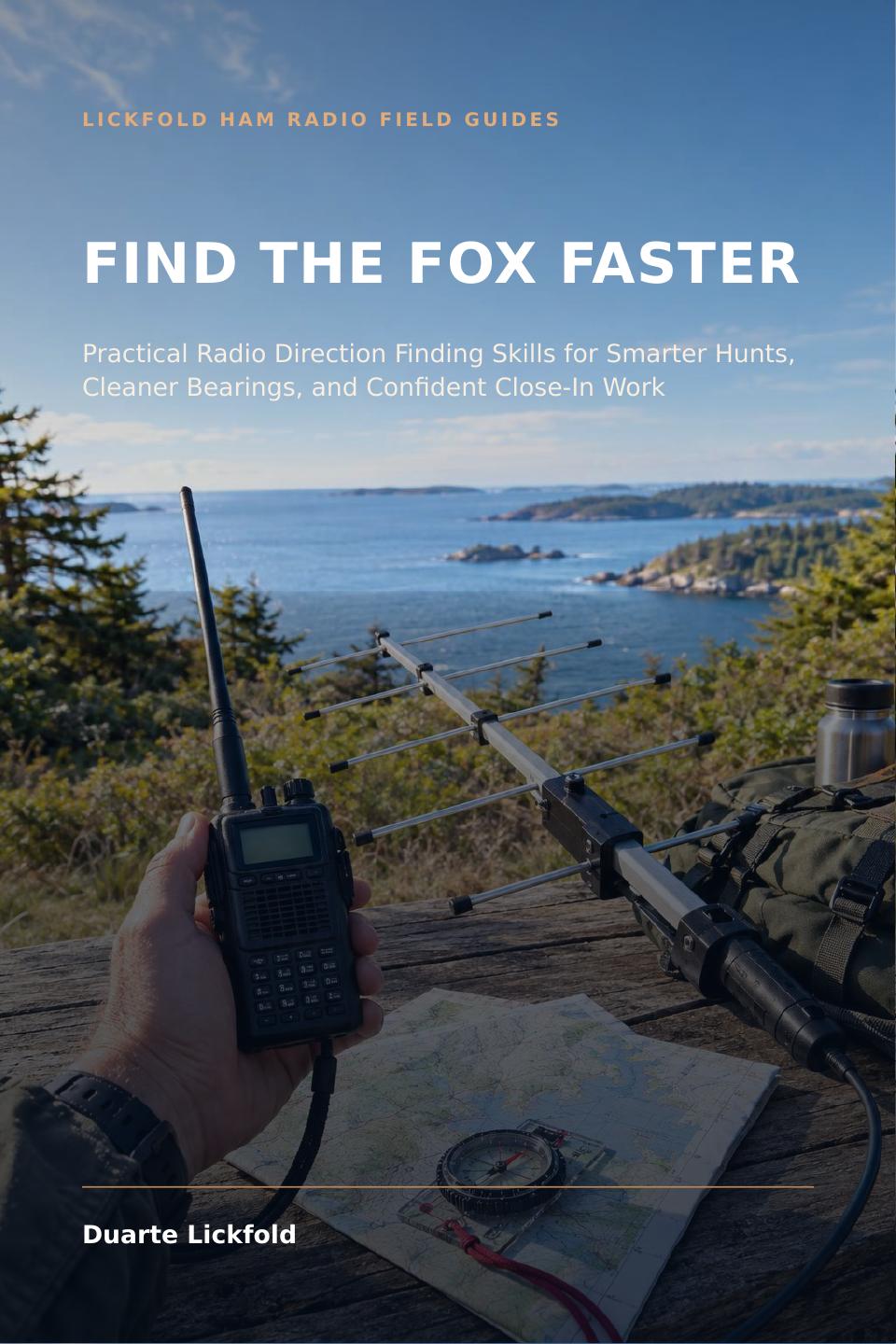
If you want a field-focused guide to these skills, Find the Fox Faster by Duarte Lickfold was written for licensed amateur radio operators who want to improve practical VHF/UHF radio direction finding. It covers RDF kits, antenna behavior, map-based bearing work, attenuation, mobile and on-foot tactics, close-in methods, troubleshooting, and practice drills in one organized foxhunting workflow.
Explore the Book
Continue learning with Find the Fox Faster by Duarte Lickfold, published by Lickfold Digital Publishers.
Check our selection of Hamradio e-books
-
Sale!

Mastering APRS
Original price was: $59.99.$9.97Current price is: $9.97.
A Comprehensive Guide – ebook
⭐⭐⭐⭐⭐
2026 Edition -
Sale!

Mastering FT8
Original price was: $59.99.$9.97Current price is: $9.97.
A Comprehensive Guide to the Ultimate Digital Mode – ebook
⭐⭐⭐⭐⭐
2026 Edition -
Sale!

Stealth CB Antennas
Original price was: $59.99.$9.97Current price is: $9.97.
A Masterclass in Innovation and Disguise – ebook
⭐⭐⭐⭐⭐
2026 Edition -
Sale!

Ace Your Ham Radio Exam
Original price was: $59.99.$9.97Current price is: $9.97.
Technician, General, and Extra Class – ebook
⭐⭐⭐⭐⭐
2026 Edition -
Sale!

DMR for Hams
Original price was: $59.99.$9.97Current price is: $9.97.
The Ultimate Beginner’s Guide – ebook
⭐⭐⭐⭐⭐
2026 Edition -
Sale!

D-STAR, DMR & Fusion
Original price was: $59.99.$9.97Current price is: $9.97.
A Beginner’s Guide – ebook
⭐⭐⭐⭐⭐
2026 Edition -

Mastering the 6-Meter Band
$9.97
The Ultimate Guide – ebook
⭐⭐⭐⭐⭐
2026 Edition -
Sale!

Integrating Ham Radio with Modern Technology
Original price was: $59.99.$9.97Current price is: $9.97.
IoT, Raspberry Pi, and More – ebook
⭐⭐⭐⭐⭐
2026 Edition -
Sale!
D-STAR, DMR & Fusion
Original price was: $59.99.$9.97Current price is: $9.97.
Guia para Principantes – ebook
⭐⭐⭐⭐⭐
2026 Edition -
Sale!
Ham Radio for Preppers
Original price was: $59.99.$9.97Current price is: $9.97.
The Essential Survival Communications Guide – ebook
⭐⭐⭐⭐⭐
2026 Edition -
Sale!

Mastering Marine Radio
Original price was: $59.99.$9.97Current price is: $9.97.
A Sailor’s Guide to Confident Communication – ebook
⭐⭐⭐⭐⭐
2026 Edition -

Worldwide DX under 5watts
$9.97
⭐⭐⭐⭐⭐
2026 Edition -
Portable Antennas That Pack Small
$9.97
⭐⭐⭐⭐⭐
2026 Edition -

Tame Your First HF Dipole
$9.97
⭐⭐⭐⭐⭐
2026 Edition -

Backyard Antennas for Tight Spaces
$9.97
⭐⭐⭐⭐⭐
2026 Edition -
First POTA Activation Playbook
$9.97
⭐⭐⭐⭐⭐
2026 Edition -

Copy CW Through Real Band Noise
$9.97
⭐⭐⭐⭐⭐
2026 Edition -
Reading the HF Sky
$9.97
⭐⭐⭐⭐⭐
2026 Edition -
FT8 Without the Frustration
$9.97
⭐⭐⭐⭐⭐
2026 Edition -
Make Your Own RF Probe
$9.97
⭐⭐⭐⭐⭐
2026 Edition

Enter shop