Description
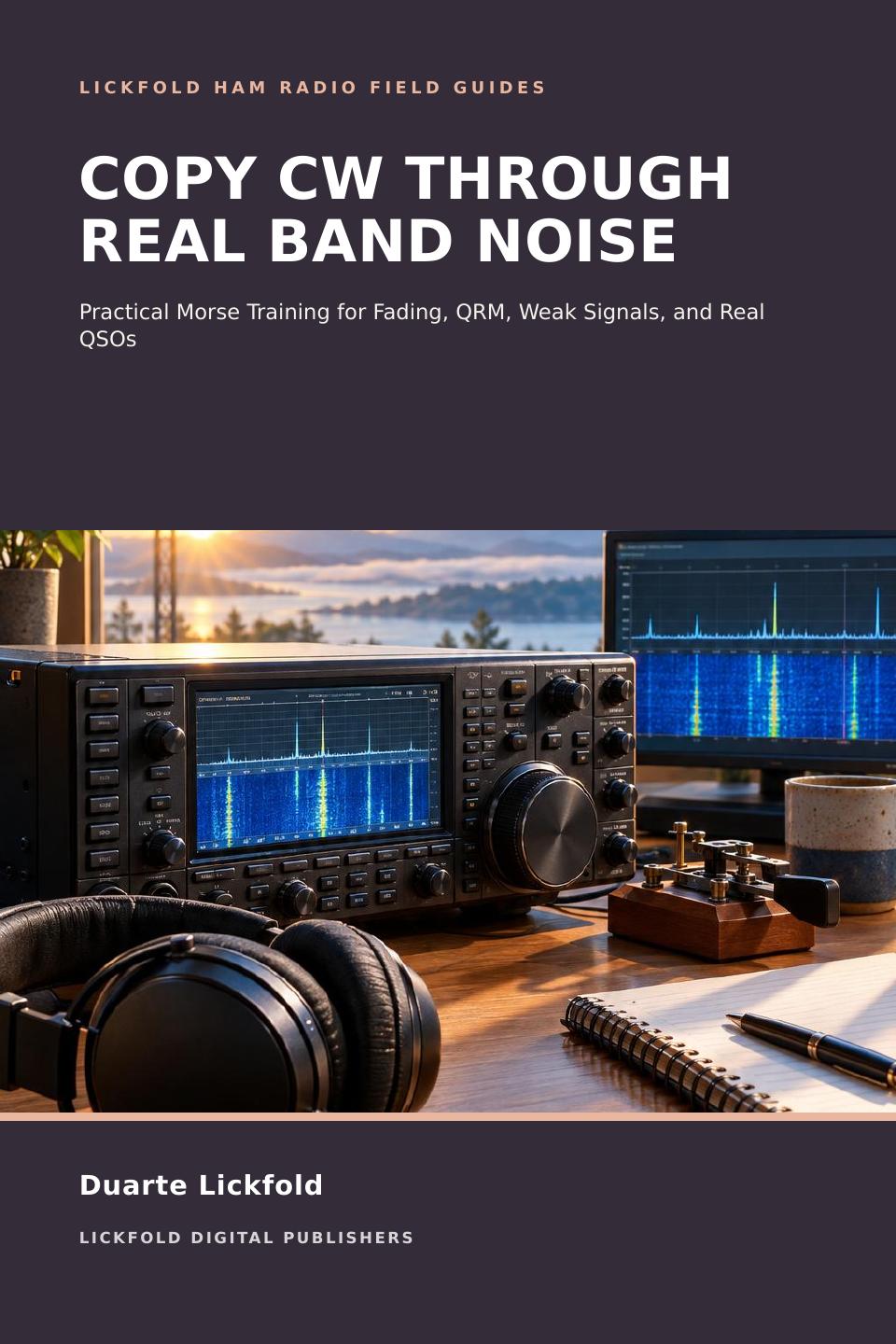
Clean Morse practice can make you feel ready. Then the band opens, the signal fades, a stronger station lands nearby, the sender has an uneven fist, and your solid copy turns into fragments. Copy CW Through Real Band Noise is written for that exact moment.
Duarte Lickfold treats real CW copy as an information-recovery skill, not a perfect transcription exam. Instead of promising instant speed or contest-level performance, this guide shows you how to extract usable, verified information from ordinary HF conditions: call signs, reports, names, QTH, station details, and closing information.
You will learn how to prepare your ear with realistic amateur-radio content, set up your receiver for readability, choose filters and AGC settings sensibly, and train with noise without simply overwhelming yourself. The book explains how to handle QSB, QRN, weak-signal fading, adjacent CW, crowded bands, drift, chirp, key clicks, and imperfect human sending.
A major focus is what to do after you miss something. You will practice marking uncertainty, rejoining at the next label, separating heard copy from inferred copy, and asking narrow repeat questions such as CALL?, NAME AGN, QTH?, or PSE RPT. The result is a calmer, more accurate approach to QSOs: copy what matters, verify before logging, and recover without freezing.
With practice plans, notation examples, receiver tactics, live-band listening methods, SDR and recording workflows, and a 90-day improvement system, this book gives developing CW operators a structured path from clean-code comfort to practical on-air confidence.
What You Will Learn
- Why real CW is an information-recovery task rather than a perfect transcription test
- How to build automatic sound-pattern recognition without falling back into dot-dash counting
- How to use QSO structure to recover from missed characters and partial words
- How to tune, center, filter, and adjust receiver gain for readable CW instead of merely louder audio
- How to train with hiss, static, fading, QRM, recordings, SDRs, and live signals in a controlled progression
- How to mark uncertainty in call signs, numbers, names, QTH, and other exchange fields
- How to handle QSB, QRN, weak signals, adjacent CW, imperfect fists, drift, chirp, and key clicks
- How to ask concise repeat questions without restarting the whole contact
- How to make real QSOs using compact scripts, note templates, and honest logging habits
- How to build a sustainable practice plan using live bands, recordings, error categories, and a speed/noise ladder
Who This Book Is For
- Licensed amateur radio operators who can recognize Morse characters in practice audio but struggle on live HF bands
- CW learners who lose copy during fading, static crashes, interference, or crowded-band conditions
- Operators preparing for modest-speed real QSOs, not just isolated character drills
- Hams who want better receiver habits for CW pitch, filtering, gain, AGC, and DSP use
- Operators who want to stop guessing and start logging only verified call signs and exchange information
- Returning CW operators who need a practical system for rebuilding real-band copy skills
Inside the Book
- 1. Why Real CW Sounds Harder Than Practice Code
- 2. Build the Ear Before Fighting the Noise
- 3. Tune, Filter, and Listen Like a CW Operator
- 4. Train With Noise Without Training Bad Habits
- 5. Copy Call Signs, Exchanges, and Meaning Under Pressure
- 6. Survive QSB, QRN, and Weak-Signal Fading
- 7. Handle QRM, Crowded Bands, and Imperfect Sending
- 8. Make Real QSOs Without Freezing
- 9. Use Live Bands, SDRs, and Recordings as a Training System
- 10. From Competent Copy to Practical Mastery
Format: EPUB eBook. Author: Duarte Lickfold. Publisher: Lickfold Digital Publishers.