Description
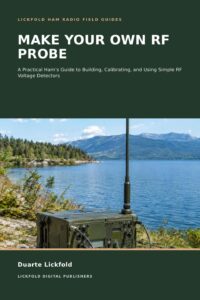
A homemade RF probe can be one of the most useful small tools on a ham-radio bench, but only when you understand what it is measuring and what it is not. Make Your Own RF Probe is a hands-on field guide for operators who want a practical RF detector for tracing signals, confirming RF presence, comparing levels, and making conservative voltage estimates without pretending a simple diode probe is a lab-grade RF voltmeter.
Duarte Lickfold walks you through the real behavior of basic RF detector circuits: diode nonlinearity, peak detection, meter loading, discharge time constants, probe capacitance, ground-lead effects, and frequency limits from HF into low VHF. You will learn how to choose the right probe style for your measurement question, select sensible parts, build a mechanically reliable high-impedance HF bench probe, and document the details that matter later.
The book also shows how to create a local calibration chart using a controlled 50-ohm dummy-load setup, while making clear why calibration depends on the specific probe, meter, frequency, layout, and test conditions. Practical chapters cover transmitter-side checks, filters and attenuators, weak-signal troubleshooting, receiver and oscillator work, kit-building applications, and the common symptoms of misleading readings.
Safety and measurement boundaries are treated as part of the build, not as an afterthought. The guide explains why homemade probes should not be casually connected to unknown high-voltage RF points, amplifier tank circuits, live tuners, or crowded circuits, and why RF exposure, spectral purity, frequency accuracy, modulation quality, and compliance questions require the right instruments.
If you want a useful bench tool and a clearer understanding of RF measurements, this guide gives you a grounded, buildable path.
What You Will Learn
- What a simple RF probe actually does, and why its DC output is not automatically RMS, peak, or power
- How diode detector circuits, capacitors, discharge resistance, meter loading, and probe capacitance affect readings
- How to choose between a high-impedance probe, a 50-ohm detector fixture, and an oscilloscope-style detector adapter
- How to select parts and build a compact high-impedance HF ham-bench RF probe
- How to perform sanity checks and a conservative first RF response test
- How to create a basic calibration chart using a controlled 50-ohm dummy-load setup
- How to use the probe for transmitter, filter, attenuator, antenna-system, receiver, oscillator, and kit-building checks
- How to recognize no readings, low readings, unstable readings, hand-capacitance effects, slow decay, and frequency-sensitive behavior
- When a wattmeter, dummy load, oscilloscope, spectrum analyzer, frequency counter, calibrated RF voltmeter, or compliance procedure is the better tool
Who This Book Is For
- Licensed amateur-radio operators who want a useful homebuilt RF bench tool
- Hams building or troubleshooting QRP transmitters, kits, oscillators, and simple receivers
- Operators who use a DMM or oscilloscope and want to add practical RF detection capability
- Experimenters who need relative RF level checks rather than certified power measurements
- Builders who want clear safety boundaries before probing transmitter or antenna-system points
Inside the Book
- 1. What an RF Probe Actually Does
- 2. RF Safety, Station Protection, and Measurement Boundaries
- 3. Detector Circuits: From RF to a Meter Reading
- 4. Choosing the Probe You Should Build
- 5. Parts, Layout, Shielding, and Mechanical Reliability
- 6. Building the Basic Ham-Bench RF Probe
- 7. Calibration Without Pretending It Is a Lab Instrument
- 8. Using the RF Probe for Transmitter and Antenna-System Checks
- 9. Receiver, Oscillator, and Kit-Building Applications
- 10. Troubleshooting Bad Readings and Improving the Probe
Format: EPUB eBook. Author: Duarte Lickfold. Publisher: Lickfold Digital Publishers.