
Join our Exclusive Ham Radio Newsletter
A first Parks on the Air activation can feel deceptively simple: bring a radio to a park, put up an antenna, make contacts, and upload the log. In practice, the first outing often reveals that portable radio is less about any single piece of equipment and more about how the whole system behaves under time, weather, terrain, battery, and attention limits.
The good news is that most first-activation problems are predictable. You cannot guarantee propagation, pileups, or a specific contact count, but you can remove many avoidable failures before you leave home. A useful first POTA plan is not built around rarity or ambition. It is built around reducing uncertainty.
Start by defining success correctly. A successful first activation is not simply “I made a lot of contacts.” A better definition is: you operated lawfully, stayed safe, respected the park, made your best effort on the air, kept an accurate log, and learned enough to improve the next outing. Administrative activation credit depends on current POTA requirements and proper submission, so it is wise to treat “making QSOs” and “having a valid submitted activation” as related but separate goals.
Park selection is the first major risk-control decision. The closest park is not always the easiest park. A better first park has clear access, predictable hours, a confirmed current park reference, reasonable parking, room to operate away from public traffic, and fewer restrictions that affect antennas or vehicle access. Before you go, check whether gates close early, whether seasonal closures apply, whether there are fees, whether masts or attachments are restricted, and whether cell service is likely. Save key details offline, because relying on internet access at the site can create an unnecessary single point of failure.
Operate well inside the apparent park boundary. Boundary assumptions are a common source of trouble for new activators. Maps, parking areas, trailheads, and adjacent public lands may not all represent the same thing. If you are unsure, choose a position that is clearly within the designated area rather than trying to operate from an edge case.
Next, think of your station as one integrated system. The radio is only one component. Power, antenna, feed line, connectors, logging method, operator position, weather protection, and setup sequence all affect whether the station works. A 20-watt radio with a suitable battery, known antenna, paper backup log, and comfortable operating layout may outperform a more powerful station that is hard to deploy or poorly tested.
Battery planning deserves more attention than it usually gets. Do not estimate runtime from transmit power alone. Radios draw current while receiving, transmitting, tuning, changing settings, and sometimes powering accessories. A simple estimate should consider voltage, amp-hours or watt-hours, receive current, transmit current, and transmit duty cycle. Then add margin. Cold weather, older batteries, digital modes, higher duty cycle, and long calling periods can all reduce your practical operating time.
Antenna choice is another place where first activators can simplify. The “best” antenna is the one you can safely and legally deploy at that specific site, with known behavior, in the time available. A half-wave dipole, linked dipole, end-fed half-wave, vertical, loaded whip, loop, or VHF/UHF antenna can all be reasonable in the right context. The question is not which antenna wins arguments online. The question is which one fits your park, supports, bands, license privileges, setup skill, and backup plan.
For a first HF activation, many operators gravitate toward 40 and 20 meters because those bands often provide useful regional and longer-distance opportunities. That does not make them mandatory. Your license privileges, antenna, time of day, solar conditions, local noise, and available hunters matter. Have a primary plan and a timed change rule. For example, if you call and spot for 10 to 15 minutes with no response after verifying the basics, reassess. Check frequency, mode, power, antenna selection, SWR, volume, RF gain, and whether you are actually being heard. Then change one variable at a time.
A dry run at home is one of the highest-value preparations you can do. Set up the exact station you intend to use: radio, battery, coax, tuner if used, antenna parts, logging device or paper log, clock or UTC reference, headphones, microphone or key, and all adapters. Do not simply inventory the gear. Assemble it. Route the cables. Confirm that the connectors match. Practice your logging flow. If you transmit during the test, do so appropriately and conservatively, using a dummy load or low-power checks where suitable. A 30-minute dry run can reveal the missing coax adapter, unclear UTC display, dead logging tablet, wrong power lead, or invisible guy line that would otherwise spoil the field session.
Logging should be treated as part of operating, not as paperwork to reconstruct later. Record the essentials clearly: date, UTC time, call sign, band, mode, and any required context for the park activation. Follow current POTA instructions for submission requirements. During the contact, repeat back uncertain call signs. If a contact is incomplete, do not turn it into a complete QSO later from memory. If you use electronic logging, bring a paper fallback. If you use paper logging, photograph or scan the log after the activation and preserve the raw record until everything is submitted and confirmed to your satisfaction.
On site, set up in a risk-based order. First observe the area. Look for overhead power lines, foot traffic, wet ground, wind exposure, fragile vegetation, and places where coax or wires could trip visitors. Keep lines visible or routed away from walkways. Fuse battery leads near the battery, protect terminals, verify polarity, and keep connections dry. If a visitor approaches the station or an unsafe condition develops, pause operating. A clean log and a few extra contacts are not worth creating a hazard in a public park.
When things go wrong, troubleshoot by category: power, RF, human procedure, and environment. No power? Check the battery, fuse, polarity, switch positions, and connectors. High SWR? Confirm the correct band, antenna links, tuner state, counterpoise or radials, feed line strain, and nearby objects. No responses? Confirm you are on the intended frequency and mode, that the antenna is connected, that volume and RF gain are reasonable, that you are not outside your privileges, and that spotting did not fail silently. Change one variable at a time and set a practical limit. After five to ten minutes of fault isolation, it may be better to simplify, change bands, switch to a backup antenna, relocate, or shut down.
After the activation, do a short after-action review while the details are fresh. Compare your plan with what actually happened. Note arrival-to-ready time, ready-to-first-QSO time, contact rate by band and mode, battery behavior, SWR observations, logging errors, comfort issues, and anything that slowed teardown. Then choose one controlled improvement for next time. Many upgrades are procedural rather than expensive: pre-marked antenna lines, a better checklist, brighter guy-line markers, a laminated band plan, a clearer UTC clock, or a dedicated adapter pouch.
The first POTA activation is not a final exam. It is the beginning of a field operating system. If you approach it with conservative planning, safe layout, redundant logging, and a willingness to learn from the result, even a modest contact count can become a useful success.
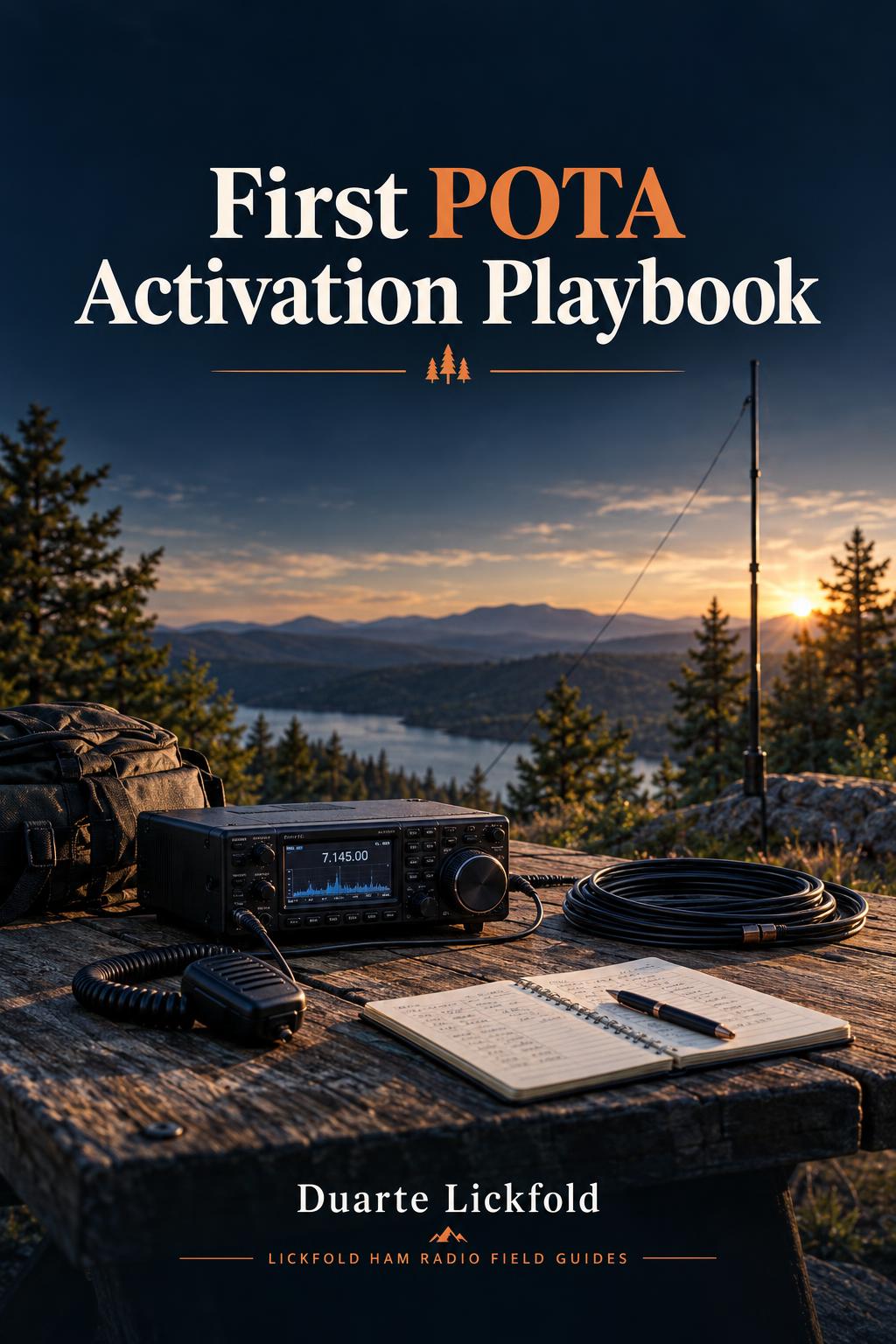
For operators who want a structured walkthrough of that process, Duarte Lickfold’s First POTA Activation Playbook is a focused field guide to planning, operating, logging, troubleshooting, and improving a first Parks on the Air activation without relying on hype or guaranteed conditions.
Explore the Book
Continue learning with First POTA Activation Playbook by Duarte Lickfold, published by Lickfold Digital Publishers.
Check our selection of Hamradio e-books
-

Worldwide DX under 5watts
$9.97 -

Portable Antennas That Pack Small
$9.97 -

Tame Your First HF Dipole
$9.97 -

Backyard Antennas for Tight Spaces
$9.97 -

First POTA Activation Playbook
$9.97 -

Copy CW Through Real Band Noise
$9.97 -

Reading the HF Sky
$9.97 -

FT8 Without the Frustration
$9.97 -
Make Your Own RF Probe
$9.97 -
Sale!

Mastering APRS
Original price was: $59.99.$47.99Current price is: $47.99.
A Comprehensive Guide – ebook
⭐⭐⭐⭐⭐ -
Sale!

Mastering FT8
Original price was: $59.99.$47.99Current price is: $47.99.
A Comprehensive Guide to the Ultimate Digital Mode – ebook
⭐⭐⭐⭐⭐ -
Sale!

Stealth CB Antennas
Original price was: $59.99.$47.99Current price is: $47.99.
A Masterclass in Innovation and Disguise – ebook
⭐⭐⭐⭐⭐ -
Sale!

Ace Your Ham Radio Exam
Original price was: $59.99.$47.99Current price is: $47.99.
Technician, General, and Extra Class – ebook
⭐⭐⭐⭐⭐ -
Sale!

DMR for Hams
Original price was: $59.99.$47.99Current price is: $47.99.
The Ultimate Beginner’s Guide – ebook
⭐⭐⭐⭐⭐ -
Sale!

D-STAR, DMR & Fusion
Original price was: $59.99.$47.99Current price is: $47.99.
A Beginner’s Guide – ebook
⭐⭐⭐⭐⭐ -

Mastering the 6-Meter Band
$47.99
The Ultimate Guide – ebook
⭐⭐⭐⭐⭐ -
Sale!
Integrating Ham Radio with Modern Technology
Original price was: $59.99.$47.99Current price is: $47.99.
IoT, Raspberry Pi, and More – ebook
⭐⭐⭐⭐⭐ -
Sale!
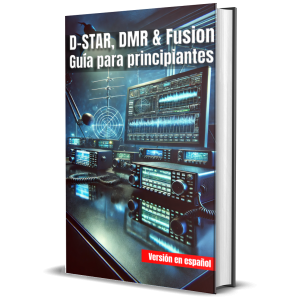
D-STAR, DMR & Fusion
Original price was: $59.99.$47.99Current price is: $47.99.
Guia para Principantes – ebook
⭐⭐⭐⭐⭐ -
Sale!
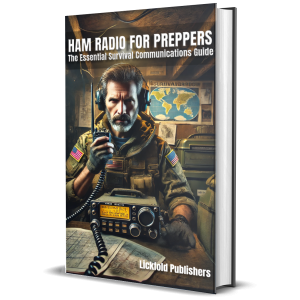
Ham Radio for Preppers
Original price was: $59.99.$47.99Current price is: $47.99.
The Essential Survival Communications Guide – ebook
⭐⭐⭐⭐⭐ -
Sale!

Mastering Marine Radio
Original price was: $59.99.$47.99Current price is: $47.99.
A Sailor’s Guide to Confident Communication – ebook
⭐⭐⭐⭐⭐

Enter shop